[Striving for progress in stability and seeing the beginning] It is difficult to overcome the difficulties. China’s foreign trade started steadily
CCTV News:Today (April 19th), we will pay attention to foreign trade. In the first quarter, China’s foreign trade increased by 10.7% year-on-year. Since the third quarter of 2020, China’s foreign trade has maintained positive growth year-on-year for seven consecutive quarters. This is a very hard-won achievement.
Last year, China’s total import and export volume exceeded 5 trillion and 6 trillion US dollars, setting a record high. On the basis of last year’s high base, China’s foreign trade still achieved a "steady start" in the first quarter, which reflected the strong resilience of China’s economy.
Under the background that the external environment is becoming more complicated and uncertain, how can China’s total foreign trade import and export value achieve "double-digit" growth in the first quarter? Facing the pressure of rising raw materials and freight, how can foreign trade enterprises reduce costs? How do the government and enterprises work together to stabilize orders and production? The reporter conducted a first-line survey in Zhejiang, a major foreign trade province.
The largest foreign trade platform enterprise in Ningbo, Zhejiang, has cooperated with more than 10,000 foreign trade enterprises. On the basis of 40% growth last year, enterprise exports continued to achieve 21% growth in the first quarter of this year. Although the increase is gratifying, Ying Xiuzhen, the person in charge of the enterprise, is staring at the two shipping price lists in his hand and calculating the cost.
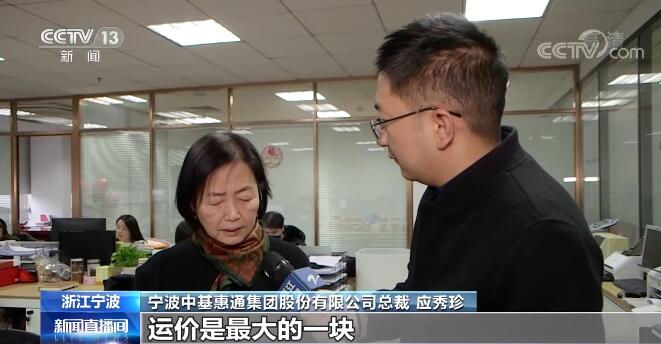
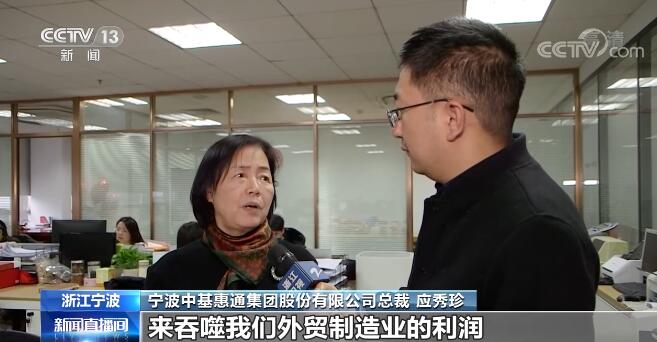
Also worried about the increase in freight is the person in charge of this foreign trade production enterprise. He calculated an account for the reporter: every time a garment is produced, the net profit is about $0.6, and once the sea freight is allocated to each garment, the profit will be reduced by at least half.
The increase in freight rates and the decrease in profits are difficult problems faced by many foreign trade enterprises. Zhang Xiaowen, head of the Foreign Trade Department of Zhejiang Provincial Department of Commerce, has held matchmaking meetings with foreign trade enterprises almost every week in recent months to discuss how to reduce costs.
Zhang Xiaowen, Deputy Director of Foreign Trade Development Department of Zhejiang Provincial Department of Commerce:It should be said that the sea freight is still a relatively concentrated problem reflected by enterprises in the first quarter, and it is also a very large piece of corporate profits.
Zhang Xiaowen told reporters that in addition to rising sea freight, foreign trade enterprises are also facing problems such as rising raw material prices and exchange rate fluctuations. Focusing on reducing the burden and relieving the difficulties, Zhejiang has made a policy "combination boxing" this year from the aspects of financing cost, credit insurance rate, exchange rate hedging, payment of handling fees, and improvement of sea-rail combined transport capacity to help enterprises reduce costs.
In Yiwu Small Commodity Market, these clothes, shoes and hats are being packed and will be sent from Zhoushan Port in Ningbo to Poland, Romania and other Central and Eastern European countries. Before the goods arrived in Ningbo, the port and dock procedures such as pre-release and pre-loading were completed online in advance.
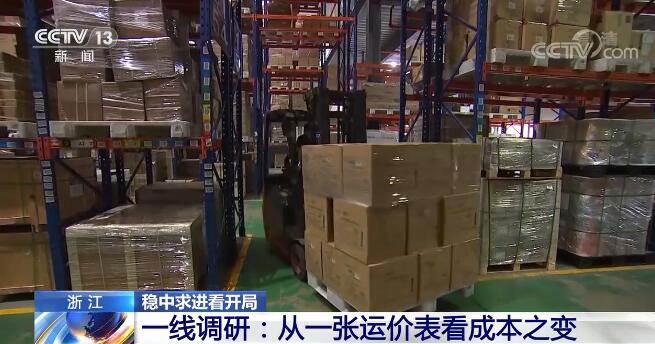
Hu Feng, Deputy Section Chief of Logistics Supervision Division II of Daxie Customs under Ningbo Customs:Through the newly-built networking system, we can see that a batch of goods sent from Yiwu commodity market have entered Yiwu Port, and then we can automatically match and release these goods exported from Yiwu Port through Zhoushan Port in Ningbo.
This newly-built networking system is called "the sixth port networking platform", which makes the goods from Yiwu entering the inland port of Yiwu equal to entering Zhoushan Port in Ningbo.

Zhang Yanfeng, General Manager of Zhejiang Shuangsi Supply Chain Management Co., Ltd.:The goods haven’t arrived at Zhoushan Port in Ningbo, and the formalities will be completed. Soon and conveniently, it is equivalent to the seamless connection between these merchants in Yiwu Small Commodity Market and Zhoushan Port in Ningbo.
Yang Jinfeng, sponsored by Yiwu Customs Supervision Division II and Level IV:Save logistics cost and time for our import and export enterprises. It is estimated that the time saved will be more than one day, and the cost will be more than 100 yuan per container.
For foreign trade enterprises that are temporarily trapped due to factors such as rising freight rates, Zhejiang also requires financial institutions not to blindly cherish loans, draw loans, break loans, and suppress loans. With the implementation of various measures, the effectiveness of Zhejiang foreign trade enterprises in reducing costs has gradually emerged. Only the letter insurance policy reduces the rate, and the amount of fee reduction will reach 45 million yuan.
Zhang Xiaowen, Deputy Director of Foreign Trade Development Department of Zhejiang Provincial Department of Commerce:Do a good job in policy reserve and policy reinforcement in a timely manner to help enterprises solve urgent and dangerous problems. Our ultimate goal is to reduce the cost of enterprises and raise profits, so that foreign trade enterprises can receive orders and make money.
Not only in the eastern coastal provinces, but also in the investigation and interview in Chongqing in the western region, the reporter learned that the three problems of lack of core, lack of cabinets and lack of work since last year and the four-liter problems of freight, raw materials, cost and exchange rate fluctuation have increased the burden on foreign trade enterprises. In this regard, how do local governments and enterprises respond? Continue to look at the reporter’s investigation.
When visiting a number of foreign trade enterprises in Chongqing Science City in the west, the reporter found that some small and medium-sized foreign trade enterprises are struggling to climb the slope due to the sluggish demand in the international market.
Ye Kai, head of enterprise procurement:The generator consists of many copper wires, and the current copper price has risen from 45,000 yuan and 46,000 yuan a ton to 72,000 yuan a ton now.

Qian Xun, head of enterprise logistics:Freight used to account for only a few percent of the total value of goods, but now it has risen to 20%— 30%.
Jing Li, head of the enterprise:We still have three sets of equipment that haven’t been delivered, and the customer has paid a certain amount of advance payment, but up to now, the customer can’t contact us and can’t get the payment. Now I don’t know where people are.
In view of the difficulties and pain points of enterprises, in Chongqing High-tech Zone Free Trade Bureau, a battle map covering more than 30 local key foreign trade enterprises is very eye-catching. On the display board, the current difficulties, solutions, progress and responsible persons of each enterprise can be seen at a glance.
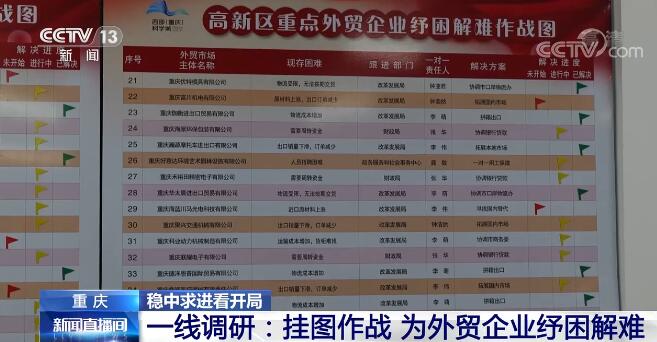
Zhong Yajun, staff member of Chongqing High-tech Zone Reform and Development Bureau:For example, we have just received feedback from the enterprise, and he can’t receive the payment, because the problem has just been received and has not yet started (solved), so we use a red flag to indicate it. What you see in yellow means that we are coordinating relevant departments to solve the difficulties and sticking points, and green means that the problem has been solved satisfactorily.
As the battle map is on the wall, all departments send special work classes to dock according to the specific conditions of enterprises, and "one enterprise, one policy" accurately implements policies and puts responsibilities on people.
Lin Li, Director of Chongqing High-tech Zone Reform and Development Bureau:For those who make rapid progress, we will award flags to praise them, and for those who make slow progress, we will also announce the bright cards.
Through the wall chart operation, all departments actively take effective measures to solve problems for enterprises. In terms of smooth international logistics, we have increased policy support for international logistics channels such as China-Europe trains, new land and sea channels in the west and golden waterways in the Yangtze River.

Qian Xun, head of enterprise logistics:Under the coordination of the government, we transferred some goods that used to be shipped by sea to China Europe. We estimated that the logistics cost could be reduced by about 10%, which eased the pressure of rising costs for enterprises.
In view of the financial difficulties of foreign trade enterprises, the tax authorities have greatly optimized the export tax rebate process, and the average time for export tax rebate has been reduced from 7 working days to 5 working days.
Lan Tingyi, Director of Export Tax Refund Service and Administration Bureau of Chongqing Taxation Bureau:Our export tax refund declaration form was cut by about one third, and the data items were reduced by about one fifth, and the average declaration efficiency was improved by 30%. In the first quarter of this year, we handled export tax rebates of more than 7 billion yuan for more than 1,800 enterprises, effectively alleviating the financial pressure on market players.
In the survey, what the reporter felt most was that the "stable start" of China’s foreign trade in the first quarter benefited from the initiative of the majority of foreign trade market players and the opportunity to find opportunities in times of crisis, and also benefited from a series of policies and measures to help enterprises cope with difficulties. On January 1 this year, the regional comprehensive economic partnership agreement, or RCEP, came into effect. RCEP, the world’s largest free trade zone, officially set sail and became an important starting point for stabilizing foreign trade in many places this year. It is worth mentioning that through RCEP, China and Japan reached a free trade arrangement for the first time. Qingdao, Shandong Province, which is geographically close to Japan and economically integrated, seized the opportunity of RCEP, stabilized orders and expanded the market.
In Qingdao, a chemical company, Liu Kun, a foreign trade salesman, is docking new orders with Japanese customers this year. The tax rate table sent by this customer shows that after RCEP came into effect, the tariff of Japanese customers purchasing products such as sodium bicarbonate produced by their own enterprises has been directly reduced from 3.9% last year to zero.

Liu Kun, Business Manager of Qingdao Gulf Group Co., Ltd.:Our annual export value to Japan is about 60 million yuan, and after the implementation of RCEP, we can enjoy a preferential tariff of about 1.2 million yuan.
With the help of RCEP policy dividend, the confidence of enterprises in exploring RCEP member markets has greatly increased. In the first quarter of this year, the order volume of enterprises in RCEP member markets increased by more than 10%. In addition to the direct benefits brought by tax reduction, the RCEP certificate of origin also allows enterprises to enjoy many tariff reductions. In the first quarter of this year, they printed 73 RCEP certificates of origin through customs.
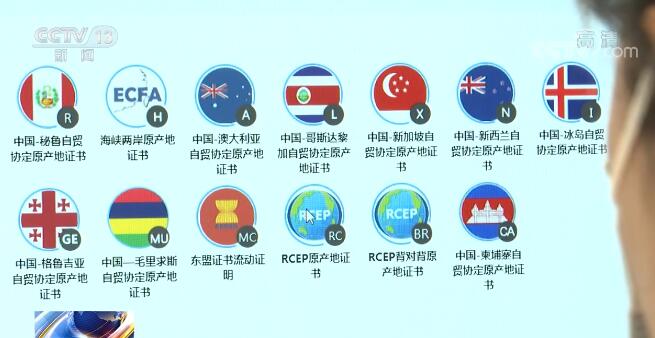
Wang Quan, Deputy General Manager of Qingdao Gulf Group Co., Ltd. Trade Branch:This is South Korea’s, this is Japan’s and this is Indonesia’s. Including tax rate reduction and tariff reduction, we enjoyed a total tariff preference of 603,800 yuan in the first quarter, which provided a good opportunity for the company’s development.
In the interview, the reporter also learned that after the implementation of RCEP, China’s previous free trade agreements with ASEAN, South Korea and other economies are still valid, and enterprises can choose the most favorable treatment independently. In a foreign trade enterprise engaged in the processing of corn products in Qingdao, the customs staff are explaining the preferential tariff rate to the person in charge of the enterprise in detail.
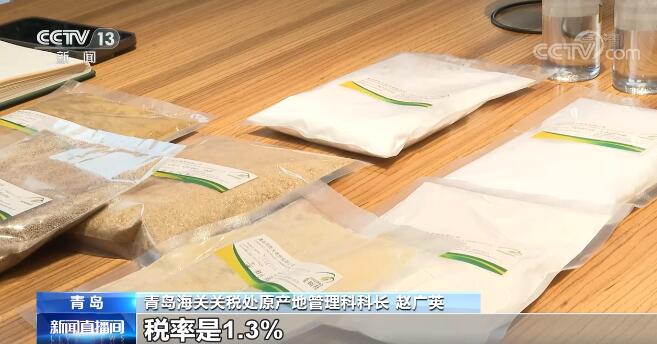
Zhao Guangying, Chief of Origin Management Section of Qingdao Customs Customs:For example, according to the RCEP agreement, the current tax rate of this lysine hydrochloride exported to South Korea is 6.1%, while according to the free trade agreement signed between China and South Korea, the tax rate is 1.3%. In this case, we will not use the RCEP rules. This yellow dextrin is exported to South Korea, and the RCEP agreement tax rate is currently 0%, while the China-South Korea FTA tax rate is 8%. It is more appropriate for us to choose RCEP for this product.
According to customs data, in the first quarter of the implementation of RCEP, Chinese export enterprises applied for RCEP certificate of origin and issued 109,000 copies of declaration of origin, with a value of 37.13 billion yuan, and enjoyed a tariff reduction of 250 million yuan from the importing country. Under RCEP, the value of imported goods was 6.72 billion yuan, and the tariff reduction was 130 million yuan.
The effective implementation of RCEP has reduced the cost of foreign trade enterprises and opened up a larger market. Affected by the global COVID-19 epidemic, in recent years, cross-border e-commerce has become one of the important graspers of "buying the world and selling it". As an important overseas node of cross-border e-commerce and a new foreign trade infrastructure, the construction of overseas warehouses is also accelerating. At present, China has built more than 2,000 overseas warehouses around the world, with a total area of more than 16 million square meters, and its business scope radiates all over the world. Let’s look at China’s overseas warehouses through a vlog.
This is Los Angeles, California, USA. Behind me is China’s largest overseas warehouse in the United States — — Warehouse 1 in California, this is Esther, the manager here. Warehouse 1 in California covers an area of about 26 basketball courts, which can accommodate about 1 million items. Today, let’s see what Warehouse 1 in California looks like.
The product around me was sent from Guangdong, China. Next, let me show you how this product reached the hands of American consumers.


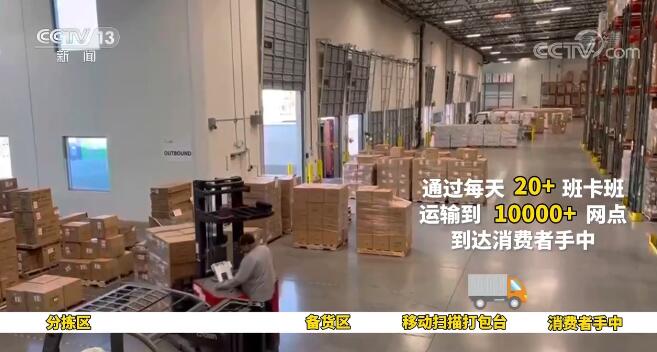
There are many products in Warehouse 1 in California that are very popular explosions. Just like this outdoor beach lounge chair, the sales volume in the past month has increased by 70% compared with the same period last year.
We hope that more and more China-made products will be sent from here in the future and delivered to American consumers as quickly as possible.
Since the beginning of this year, a series of measures have been actively introduced from the central government to the local government to solve the difficulties in the supply chain of the foreign trade industry chain and help small and medium-sized foreign trade enterprises to prevent risks, reduce costs and increase vitality. The hard-won foreign trade report card once again shows that the fundamentals of China’s strong economic resilience and long-term improvement have not changed, and the development trend of foreign trade has not changed. At the same time, it also strongly demonstrated the great achievements China has made in coordinating epidemic prevention and control and economic and social development.
Of course, it should also be noted that China’s foreign trade still faces many difficulties and pressures while achieving a smooth start. From an international perspective, the bottleneck of global supply chain has not been alleviated, inflationary pressure has risen, monetary policies in major economies have tightened, and the growth rate of global economy and trade has declined. From the domestic point of view, local epidemics have occurred frequently recently, and the production and operation of some foreign trade enterprises have been affected. Faced with these difficulties and challenges, how can China’s foreign trade maintain stability and improve quality? Under the background of high base last year and frequent outbreaks at present, how to look at the achievements of foreign trade in the first quarter? In the future, what should we do to ensure the steady growth of foreign trade throughout the year?
Special commentator Yang Wei:It is no accident that China’s foreign trade increased by 10.7% in the first quarter. The performance of foreign trade in any quarter or year does not exist in isolation, nor is it accomplished by cramming, but thanks to China’s adherence to the general trend of opening to the outside world. For example, an important reason why ASEAN returned to China’s largest trading partner in the first quarter was that RCEP came into effect this year, and the import and export scale between China and ASEAN accounted for nearly half of the total foreign trade scale with RCEP trading partners. Tianjin Port and Qingdao Port are welcoming more cargo throughput and more tax rate options, all of which are sharing the latest dividends brought by RCEP. In recent years, economic globalization has encountered counter-current. The more counter-current strikes, the more valuable it is to adhere to the correct trend of open cooperation. When the COVID-19 epidemic began to spread around the world the year before last, there was even an international argument that globalization would end. In June of that year, China announced the overall plan for building Hainan Free Trade Port. As the Supreme Leader General Secretary said, China is firmly on the right side of history.

Yang Wei:Capacity building is embodied in many aspects. Last week, General Secretary of the Supreme Leader visited Hainan and went to see Yangpu Port. The port of registry of China Yangpu Port is being built there, and the route has achieved full coverage of Southeast Asian countries and major coastal ports in China. The overseas warehouse mentioned in the report belongs to the capacity building of new foreign trade infrastructure. In recent years, China’s foreign trade enterprises generally attach importance to their own capacity building, including production capacity, the ability to build and maintain upstream and downstream industrial chains, and the ability to digitally transform. Behind capacity building is system building. The relevant departments in Chongqing, which are involved in the wall chart operation mentioned in the report, have set up a platform to serve foreign trade enterprises based on the system construction of the Pilot Free Trade Zone. There are many requirements for system construction in the top-level design documents involving foreign trade and foreign investment adopted by the Central Committee for Deep Reform in recent years.

Yang Wei:There are effective systems and conscientious teams. Team building in the field of foreign trade includes entrepreneurs, as well as teams providing services to foreign trade enterprises. Openness is also reflected in the team building. For example, the team building of Yangpu Port is based on Hainan, facing the whole country and the world. The chief shipping officer there is from Shanghai, the chief development officer is from Shenzhen Qianhai, and the chief planner is from Singapore. The general secretary said there that more international talents are welcome to Hainan.

Yang Wei:The development of foreign trade needs partners. Since entering the new era, we have more and more deeply realized that the "circle of friends" that has withstood the test of wind and rain is stronger. In the first quarter of this year, China’s imports and exports with its major trading partners all increased, including ASEAN, the European Union, the United States, South Korea and Japan. There are several key reasons why China’s "friend circle" of foreign trade is getting stronger and stronger: First, China has more and more powerful production capacity and consumption capacity, which all parties can’t ignore; Second, China has always adhered to a high level of opening to the outside world, which has formed stable expectations for trading partners; Third, China is always willing to share the market, opportunities and development dividends with its partners. Therefore, this "friend circle" of foreign trade is getting bigger and stronger.
(CCTV reporter Zhang Qin Yue Qun Liu Ying Zhang Daofeng Sun Qiang Fa Qi Zhang Hao Zhejiang Taiwan Ningbo Taiwan Shandong Taiwan Qingdao Taiwan)