There is a "purple beauty" in the courtyard!
A few days ago, the large-scale network theme interview activity of "Happy Flowers Bloom in New Frontier" entered Xing ‘an League and Hulunbeier City in Inner Mongolia, and conducted in-depth research and interviews on the new practices, new paths, new explorations and new achievements of fighting poverty and building beautiful homeland.
Small garlic was planted in the courtyard, and Wusan Village got rid of poverty and became well-off

The picture shows a vegetable garden in a farmer’s home in Wusan Village, Taiping Township, Tuquan County, Xing ‘an League, Inner Mongolia. (Duan Xingyu Photography)
Garlic has been planted in the courtyard of Wusan Village, Taiping Township, Tuquan County, Xing ‘an League for more than 30 years. The villagers used the unique local soil conditions and rich planting experience accumulated in past dynasties to continuously expand the planting scale of purple garlic in Wusan Village.
Nowadays, purple garlic planting industry has become the leading industry in the courtyard economy of the village, and more and more people have become rich by planting purple garlic.
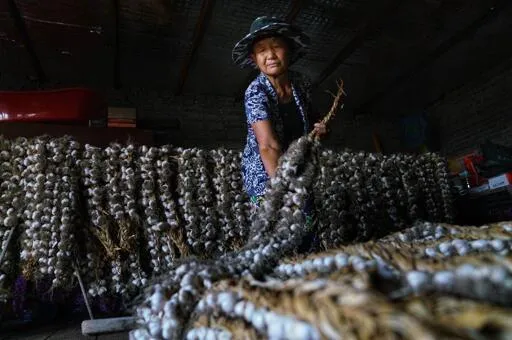
The picture shows that farmers are sorting out the braided garlic. (Huangfu Wanli Photography)
Yang Baotian, Party Secretary of Taiping Township, said: "Planting purple garlic in the courtyard has been realized ‘ Busy for half a year, two money for half a year ’ The labor intensity is not high and the benefits are good, especially suitable for the elderly and poor people with poor labor ability. "
Today, more than 200 acres of courtyard land in Wusan Village can produce about 4 million garlic, with an income of more than 10,000 yuan per acre. The per capita income of farmers is 5000 yuan. There are 29 poor households with 56 people in Wusan Village, and all of them have been lifted out of poverty.

The picture shows the villager Xu Hechun holding his own purple garlic with a smile. (Huangfu Wanli Photography)
In the yard of 66-year-old Xu Hechun’s house, there are a lot of purple garlic braided, and one garlic braid has braided a hundred garlic. Pointing to the vegetable field in his yard, he calculated a fortune account with the reporter: "In my family’s field, planting garlic in spring can first harvest garlic moss, then harvest purple garlic, and then plant Chinese cabbage." An acre of real estate garlic is about 20,000 heads, each head is 50 cents, and it can sell for 10,000 yuan; The yield of garlic moss per mu is about 400 kg, and the income is 2,000 yuan per kg of 5 yuan. Cabbage can receive about 20 thousand Jin, 20 cents per Jin, and the income is 4000 yuan. The total gross income is 16,000 yuan. Excluding the cost, the net income can reach more than 10,000 yuan. "

The picture shows a happy smile on the face of villager Wang Jinxia. (Huangfu Wanli Photography)
Wang Jinxia, a 67-year-old poverty-stricken household who set up a card, mentioned the government’s help to her and kept saying, "They are my most grateful people. Without them, there would be no happy life for me today."
In 2011, Wang Jinxia’s husband died of illness, which made the family’s economic situation worse. In 2015, helping units and cadres began to help her develop garden planting: "Xu Hechun is an agricultural extension worker in the village. He often comes to my home to talk about purple garlic planting technology, and the resident team and village cadres also help me plant it. Purple garlic has become my family’s poverty alleviation ‘ Zifumei ’ 。”
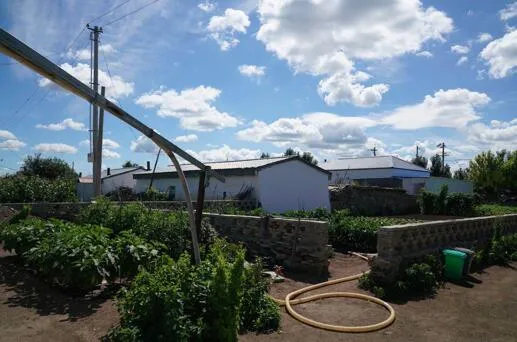
Wang Jinxia’s neat little yard (Wu Nan photography)
Although Wang Jinxia’s farm yard has only one acre of land, it is still kept clean and the crops are even more uniform. She proudly mentioned the purple garlic in her own field: "Although the garden is not big, it brings me a lot of benefits every year. I grow purple garlic except the vegetables I eat at home."
From watching the weather to watching the data, smart agriculture takes root here.
Watching 10,000 mu of rice waves, enjoying 1,000 mu of flowers and looking up at the starry sky in the cabin, this season, entering the National Modern Agricultural Industrial Park in Zalaite Banner, Xing ‘an League, Inner Mongolia, seems to have entered a beautiful scenic spot. Here, the romantic and pleasant pastoral life is desirable, and the gorgeous turn of traditional agriculture is even more surprising.
Working in the field gets rid of relying on the sky to eat and turns to digital and precise management; Green and organic rice "rises from the wind and water", and its quality has steadily improved; The deep integration of agriculture, literature and tourism promotes farmers’ income in many ways … … A series of new technologies and new models have enabled smart agriculture to take root here and inject new impetus into the implementation of rural revitalization.

Rice in the Science and Technology Service Center of "Internet of Things+Smart Agriculture" in Zhalaite Banner National Modern Agricultural Industrial Park (Economic Daily-China Economic Net reporter Zhang Xiangcheng/photo)
A grain of rice with identity
"Zhalaite rice, a rice with identity." Smart brain in industrial park — — "Internet of Things+Smart Agriculture" Science and Technology Service Center, AR voice broadcast has aroused people’s interest.
"Excuse me, what is the rare earth element?" "What Causes Rice Lodging" … … On the big screen of the intelligent brain, the reporter saw some questions from farmers. Xu Huimin, director of the Industrial Park Management Committee, introduced that the "Handheld Industrial Park" exclusive App customized and developed by the Industrial Park has many functions, such as online training, early warning of agricultural conditions, planting guidance, and release of supply and demand, which provides guidance for farmers’ production.
"Our industrial park laboratory gives digital guidance to farmers from planting to harvesting, including seed, soil, water and fertilizer testing, and gives specific opinions to achieve the goal of high yield." Wang Xiaojuan, an associate researcher of Xinjiang Tianye Group, who came to the industrial park for guidance, introduced. For example, in the past, when farmers processed the dried rice, they would habitually take a bite to see how it was sunned. Now, they can directly look at the data, that is, look at the water content, and the rice can be processed with a water content of about 15%, which is equivalent to letting farmers change from experience farming to relying on data farming.
In addition, after the rice is sold, consumers can scan the code and trace the source with one key, not only to see the origin information, but also to see the whole growth process of rice from seeds. In this way, a bridge of trust has been built between farmers and consumers.
It is understood that this year, the industrial park launched the public brand digital identity management service system of "Xing ‘an League Rice Zhazha Special Flavor Rice", distributing "one thing and one yard" digital "ID cards" for high-quality agricultural products, and establishing an agricultural product evaluation management system including food safety, regional characteristics, benefiting farmers and helping each other, and realizing industrial digitalization and digital industrialization. "In the past, it was farming by looking at the sky. Now it is farming by looking at the data. It is very promising for farmers to increase their income this year. In the next step, we must increase publicity and training, so that our large grain growers and enterprise cooperatives can understand smart agriculture and use their smart brains to increase their income and get rich. " Xu Huimin said.
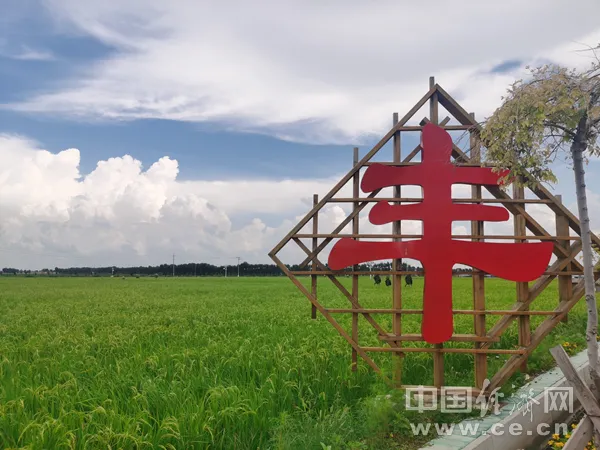
Rice fields in Zhalaite Banner National Modern Agricultural Industrial Park (Economic Daily-China Economic Net reporter Wu Xiaojuan/photo)
Green organic rice "wind and water rise"
Rice grows in the water, ducks play in the water, and fish, shrimp and crabs swim in the water. This kind of dynamic and static picture is a portrayal of ecological breeding in the industrial park.
In recent years, in order to solve the bottleneck of increasing farmers’ income, we have adjusted the planting structure and focused on developing green organic rice. Lu Yongze, deputy secretary of the Party Committee of Haolibao Town, said that the yield per mu of ordinary rice has now exceeded 1,200 Jin, and there is limited room for yield improvement, and the price is relatively low. After turning to planting green organic rice, the "high quality" agricultural products can be "excellent price".
Haolibao Town is the core area of Zhalaite Banner National Modern Agricultural Industrial Park, with an area of 280,000 mu of cultivated land, including 150,000 mu of paddy fields. Good ecology produces high quality rice. Fish, lobsters, crabs, ducks, etc. grow in rice fields, realizing a new model of modern agricultural development of "multi-purpose, multi-purpose and multi-harvest in one season", which not only saves water and soil resources, improves the utilization rate of resources, but also improves the quality of rice, giving birth to "one acre of land" in personal tailor. "Ducks, fish, shrimps and crabs can survive very well, which shows that our rice is green and ecological. If chemical fertilizers and pesticides are used, it is difficult for them to survive." Lu Yongze said.
Now, private ordering and claiming agriculture in Haolibao Town has become a common practice. Lu Yongze introduced that claiming the customers of the base ensures an annual output of more than 400 kilograms of high-quality rice per mu, among which rice fish, rice shrimp and rice crab also belong to customers. Claiming the rice field industry has freed farmers from the dependence on production, and changed the old way that rice can be served on the table through many intermediate links, thus ensuring the quality of agricultural products from the source. At present, there are 8 such customized claim bases in the town, totaling 16,000 mu, and more than 2,000 mu have been customized, achieving an average net income increase of about 3,000 yuan per mu.

Marigold Flower Sea in Zhalaite Banner National Modern Agricultural Industrial Park (Economic Daily-China Economic Net reporter Wu Xiaojuan/photo)
Deep integration of agricultural, cultural and tourism
Ten thousand mu of land, rice waves like the sea, breeds infinite hope; Thousands of acres of marigold swaying in the wind, competing to bloom; A hundred acres of lavender sea of flowers is beautiful and charming, intoxicating; Love sculptures, windmill mills and wooden plank roads dotted in flower fields have attracted many tourists to stop and watch and take pictures. Farmland turned into scenic spots, rural areas into parks, and Haolibao Town promoted the deep integration of agriculture, culture and tourism, and achieved a new level of rural tourism.
Hu Xiyuan, propaganda member of the Party Committee of Haolibao Town, told the reporter that 1,000 mu of marigold was planted by Wudaohe Agriculture and Animal Husbandry Cooperative in Wudaohezi Village of Haolibao Town, with an average yield of about 2 to 3 tons per mu, and the purchase price of foreign merchants was 1,100 yuan/ton, with considerable economic benefits. In addition, the change of farmland into landscape has also promoted the employment of the surrounding labor force and increased the tourism income of farmers.
At present, the industrial park takes advantage of the unique geographical advantages of Haolibao Town to create a 30-kilometer bicycle loop line, "rice field painting" and "rice dream starry sky" and other rice field characteristic landscapes, and to build a homestay area, including restaurants, clubs, commercial streets, amusement parks and other entertainment facilities. "Farmland turns into scenic spots and rural areas into parks, which means increasing farmers’ income in many ways." Lu Yongze said.