The strength of government affairs hall: from single approval to comprehensive service
As of April this year, local people’s governments at or above the county level have set up 3058 government affairs halls; The average processing time for enterprise registration was shortened from 16.8 days to 3.4 days; 179,000 items in 2,985 halls can be settled immediately … … The government affairs hall is using multiple service strengths to "circle the powder", and many tasks of the "streamline administration, delegate power, strengthen regulation and improve services" reform have achieved results, which has facilitated the business people to do things, and the "people running less errands" has been continuously promoted.
Recently, the General Office of the State Council organized a seven-month survey of the national government service system. On November 23, the "Report on the General Survey of Government Affairs Halls of National Comprehensive Entities" was released.
Online reception, offline hall undertaking.
In recent years, the construction of entity government affairs hall in China has made great progress and ushered in many changes. It has gradually developed from a unit window where local governments provide centralized services to an important platform for governments at all levels to carry out government services.
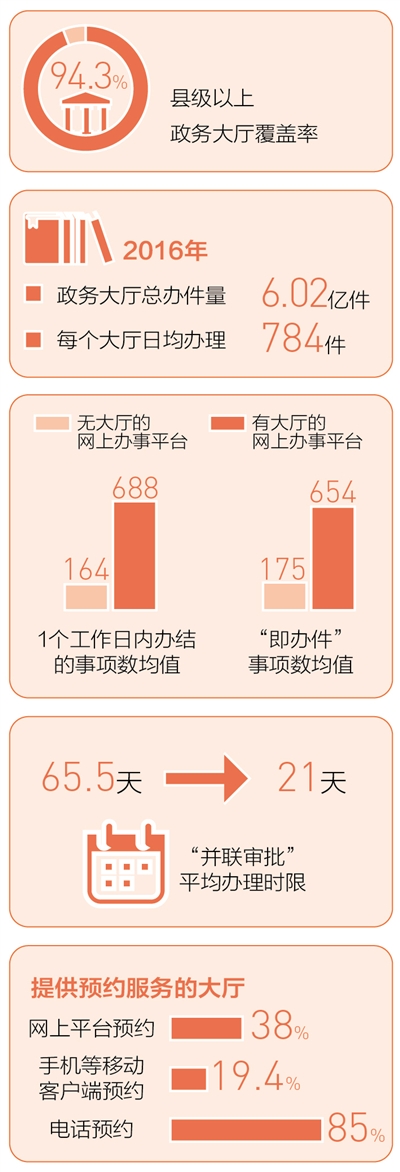
At present, the coverage rate of government affairs halls has exceeded 90%, the outlets have achieved full coverage, and the national government service system has taken shape. According to the census, as of April 2017, the coverage rate of government affairs halls of local people’s governments at or above the county level was 94.3%. Among them, there are 19 provincial government affairs halls (including Xinjiang Production and Construction Corps), 323 prefecture-level government affairs halls, 2,623 county-level government affairs halls, and 93 district and county government affairs halls directly under the central government; The coverage rates are 59.4%, 96.4%, 94.2% and 100% respectively.
The State Council has set up 42 government affairs halls. Seven provinces (regions) in Jiangxi, Guangxi, Sichuan, Guizhou, Yunnan, Gansu and Ningxia have achieved full coverage of government affairs halls at the provincial, city and county levels.
In addition, most government affairs halls have changed from single approval to comprehensive services. Government affairs halls at all levels actively promote the comprehensive stationing of examination and approval departments and matters, especially the service matters that are highly concerned by the masses and have a large amount of handling, and constantly expand their service functions.
According to the general survey, 79.4% of the office work in the country is in the lobby, far exceeding the Internet platform. Among them, 86.9% of the work done in prefecture-level cities takes place in the government affairs hall, and 97% in the western region. There are 471 government affairs halls in the country with a unified 12345 government service hotline, and many government affairs halls are equipped with professional guidance and supervision personnel to carry out consultation and guidance.
It is worth mentioning that in recent years, various localities and departments have worked hard to promote the online and offline integrated operation of the government affairs hall. All offline entity government affairs halls and online service platforms have achieved a set of systematic and integrated operations, and all of them have achieved good practical results. Online reception and offline hall undertaking make it more convenient for enterprises to do business and start businesses.
Taking the online service platform of prefecture-level cities as an example, the platform supported by the government hall can accept 50.5% more administrative licensing items than the platform without the support of the government hall.
Over 90% of the halls establish a one-time notification system.
Gu Ping-an, a professor at the National School of Administration, said that the substantive government affairs hall is an important "front desk" for serving the masses, the most direct channel for the masses to experience the achievements of government reform, and the place to find and solve problems. Doing a good job in the substantive government affairs hall is an important starting point for promoting the "streamline administration, delegate power, strengthen regulation and improve services" reform.
According to the general survey, the government affairs halls in various places have given full play to the advantages of directly serving the masses of enterprises and achieved various construction results.
It has become the main platform for the implementation of reform measures such as the list of powers and responsibilities system and the integration of multiple certificates. There are 514,000 administrative licensing items in the national government affairs halls, and each government affairs hall can handle 168 items on average. In the process of implementing "multi-certificate integration", the average time limit for enterprise registration was shortened from 16.8 days to 3.4 days, with a compression rate of 79.8%. In addition, 179,000 items can be completed immediately, and it is desirable to wait immediately; 924 government affairs halls carry out license delivery services, effectively reducing the number of people running errands.
Deepen the reform of the administrative examination and approval system. Government affairs halls are moving towards "one-stop examination and approval service". 89.4% of government affairs halls have implemented the "two centralization and two in place" reform, and the functions of administrative examination and approval and government affairs services have been cleaned up and merged. For example, the proportion of departments in Tianjin, Zhejiang and Shanxi is over 50%. To achieve "one seal for examination and approval", 180 administrative examination and approval bureaus have been established nationwide, and 15 administrative functional departments and 119 examination and approval items have been transferred on average.
Promote service process optimization. A total of 173,000 items were optimized in the national government affairs hall. Among them, the top five items handled in each hall decreased by a total of 34,409 documents, with an average decrease of 14 documents for each item, with a reduction rate of 60.2%. 73.4% of the government halls provide appointment service, and 855 halls provide full-time free agency service, involving 669,000 items; Multi-site government service halls will provide round-the-clock service on holidays.
Promote the sunshine operation of administrative power. 77.2% of the government halls have established electronic monitoring systems, 82.5% have carried out video monitoring, 74.1% have set up on-site complaint acceptance areas, and 89.7% have publicly monitored telephone calls. More than 90% of the halls have established a one-time notification system and a staff code of conduct system, and more than 80% of the halls have established a time-limited completion system, a first-inquiry responsibility system, a complaint handling system and a responsibility investigation system.
Six difficulties still need to be overcome in government service.
The survey shows that there are still significant differences in the nature of the organization, the establishment of functions, and the relationship with business departments and information departments in different places. The further development faces problems such as inconsistent understanding, unbalanced development, inadequate services, difficult information sharing, difficult departmental coordination, and difficult platform coordination.
For example, on average, 21.5% of the examination and approval departments and 36% of the administrative licensing items are still not stationed in the government affairs hall; Because the authorization is not in place, many matters still need to be returned to the department for stamping; More than 70% of the comprehensive examination and approval management platforms established nationwide failed to share data with the departmental office system; For another example, due to the lack of a unified management organization at the national level, there is no subordinate relationship between government affairs halls at all levels, and there is a phenomenon of "multiple demands, but no one is in charge" … …
"On the whole, the work of the entity government affairs hall in China has made rapid progress, but there are still many problems under the rhythm of China’s rapid social and economic development. This time, it’s timely to touch the bottom of the family. It is to make overall plans for the reform of government services in China to enter a new era, find problems and sum up experience, in order to further deepen ‘ Streamline administration, delegate power, strengthen regulation and improve services ’ Reform provides new ideas and accumulates new measures. " Gu Pingan believes.
Where there are people, there is a government affairs hall. The next step is to make it better, bigger, stronger and more practical. The "Report" suggests improving the system and mechanism of government services, speeding up the introduction of service norms and management methods, and promoting the unified standardization of stationed services; Accelerate the construction of the comprehensive examination and approval service system in the government affairs hall, connect the business systems of various departments, and promote the sharing of government information; Promote the integration of government affairs hall service system and online system, and promote the integration and development of online and offline platforms; Strengthen the construction of government affairs halls and grassroots convenience service points.
Source of data: National General Survey Report of Government Affairs Halls of Comprehensive Entities.
Cartography: Li Ziyue