This round of administrative division adjustment inventory: five cities expand, and three cities set up cities from counties.
Since June this year, the curtain of administrative division adjustment in 2020 has been opened. According to the statistics of The Paper, as of press time, five cities, including Chengdu, Changchun, Yantai, Xingtai and Wuhu, have completed expansion, and three counties, including Tongren County in Qinghai, longnan county County in Jiangxi and Wuhu County in Anhui, have completed the withdrawal of counties and the establishment of cities.
The so-called "urban expansion" is generally completed by "removing counties and setting up districts", that is, transforming counties or county-level cities into municipal districts, so that previously relatively independent counties can be brought under the jurisdiction of cities and develop as a whole.
The so-called "removing counties to set up cities" refers to turning counties into county-level cities, aiming at promoting new urbanization and promoting the urbanization of agricultural transfer population in situ and nearby.
Judging from the cities expanded this time, Chengdu, Sichuan and Changchun, Jilin are both provincial capitals, Wuhu ranks second in GDP in Anhui Province, and Yantai ranks third in GDP in Shandong Province. It can be seen that "removing counties and setting up districts" is generally a measure when the city develops to a certain stage and the next step of development and construction is facing constraints. For example, in 2001, Hangzhou announced the abolition of Xiaoshan City and Yuhang City and the establishment of Xiaoshan and Yuhang Districts.
Lin Tuo, a professor at the School of Urban and Regional Sciences of East China Normal University, told The Paper (www.thepaper.cn) that the above-mentioned series of urban expansion actions are aimed at making advantageous areas have more room for development and enhancing the comprehensive carrying capacity and optimal allocation of resources.
Chengdu, Sichuan: Xinjin County is divided into districts.
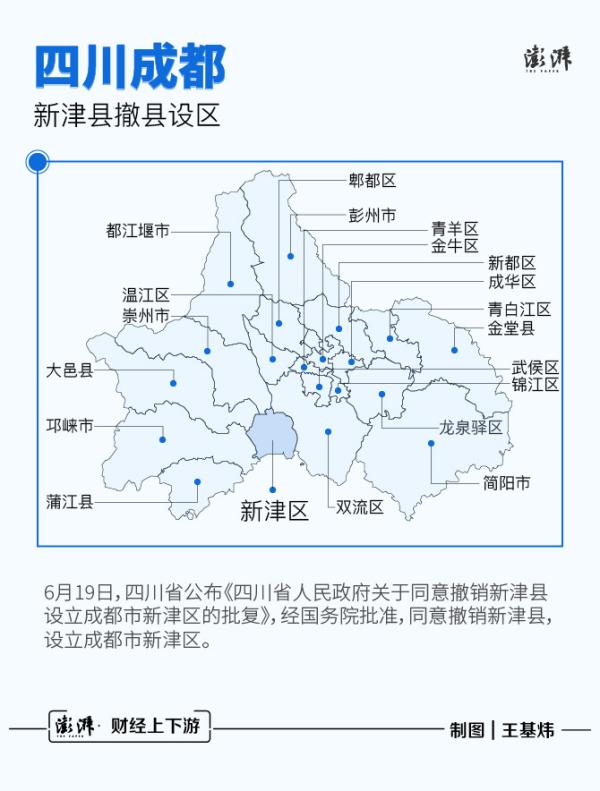
On June 19th, Sichuan Province announced the Reply of Sichuan Provincial People’s Government on Agreeing to Cancel Xinjin County and Establish Xinjin District in Chengdu. With the approval of the State Council, it agreed to cancel Xinjin County and establish Xinjin District in Chengdu. On June 30th, Xinjin District of Chengdu was officially listed.
The Sichuan Civil Affairs Department said that the establishment of Xinjin District in Chengdu is conducive to optimizing the spatial structure of Chengdu, enhancing the comprehensive carrying capacity and resource allocation capacity of the central city, and improving its radiation-driven role; It is conducive to accelerating the construction of the twin-city economic circle in Chengdu-Chongqing area and forming an important growth pole for high-quality development in the west; It is conducive to the in-depth implementation of the new urbanization strategy and the development strategy of "one stem and many branches" to promote the high-quality development of Sichuan Province; It is conducive to Chengdu to practice the new development concept, build a park city demonstration area, improve the quality of urban functions, and promote the modernization of the governance system and governance capacity of megacities.
Changchun, Jilin: Gongzhuling City is placed under the custody of Changchun City.
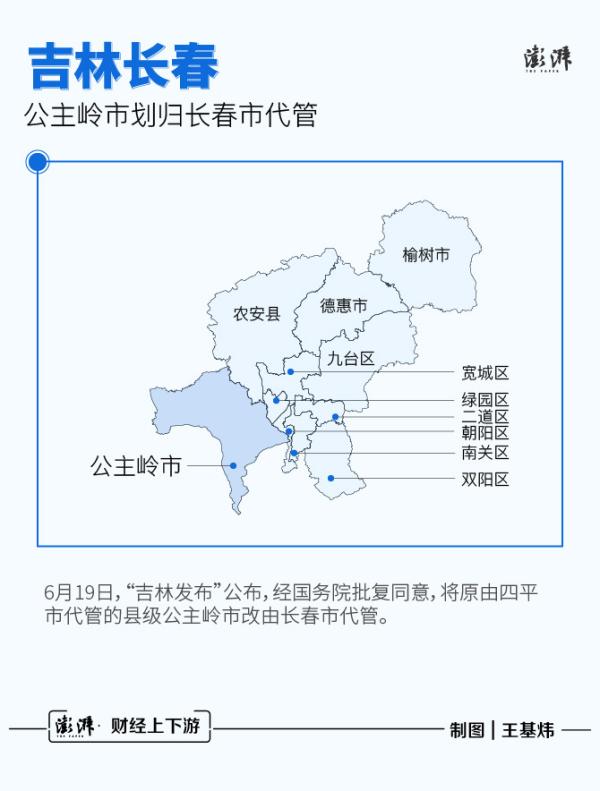
On June 19th, Jilin Province announced that with the approval of the State Council, the county-level Gongzhuling City, which was originally hosted by Siping City, will be hosted by Changchun City.
Bayin Chaolu, secretary of the Jilin Provincial Party Committee, said at the "Working Meeting on Changing the Hosting Relationship of Gongzhuling City" that it is necessary to take the opportunity of changing the hosting relationship of Gongzhuling City and adjusting administrative divisions to comprehensively promote the coordinated development of the urbanization of Gongzhuling in Changchun, accelerate the cultivation and make every effort to build a modern metropolitan area in Changchun, and promote the development of central urban agglomerations and central innovation and transformation core areas.
Bayin Chaolu also stressed that it is necessary to speed up the construction of "Great Changchun" through the coordinated development of Gongzhuling in Changchun, and strive to build Changchun into a core city of Harbin-Changzhou urban agglomeration and an international automobile city with international influence, effectively enhance its position in the whole Northeast plate, enhance its core competitiveness, and further highlight Changchun’s location advantage in the center of Northeast China.
Yantai, Shandong Province: Penglai City and Changdao County were abolished and Penglai District was established.
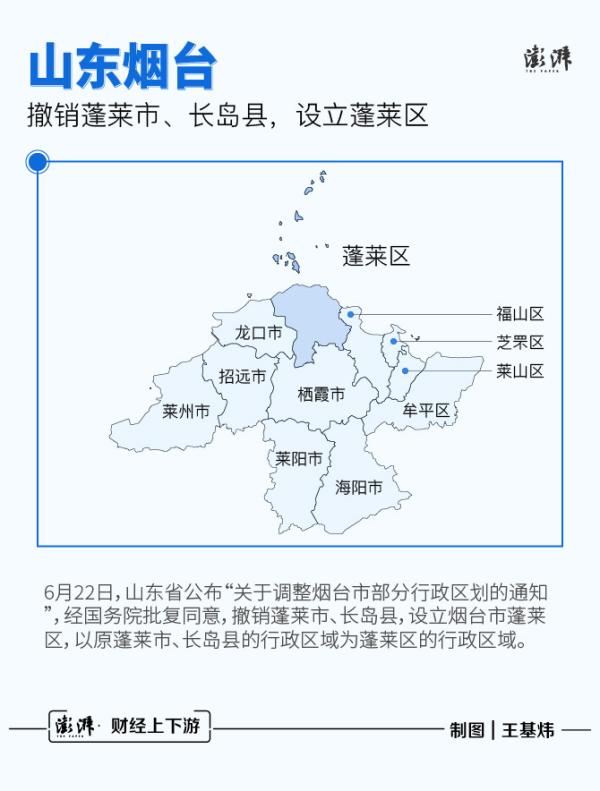
On June 22nd, Shandong Province announced the "Notice on Adjusting Some Administrative Divisions of Yantai City". With the approval of the State Council, Penglai City and Changdao County were abolished, and Penglai District of Yantai City was established, with the original administrative areas of Penglai City and Changdao County as the administrative areas of Penglai District.
The Paper (www.thepaper.cn) reporter noted that Long Island and Penglai play an extremely important role in Yantai’s future traffic planning and layout. In the planning of Bohai Bay cross-sea passage connecting Yantai, Shandong and Dalian, Liaoning, the starting point of Shandong side is Penglai-Long Island.
At this year’s two sessions of the National People’s Congress, Zhang Shuping, deputy to the National People’s Congress and secretary of Yantai Municipal Party Committee, suggested speeding up the construction of a direct express passage across the Bohai Strait to solve the land-sea connection problem between Shandong Peninsula and Liaodong Peninsula.
According to Shandong media reports, Penglai District of Yantai City will be officially listed in early September.
Xingtai, Hebei Province: Three counties were abolished and two districts were established.
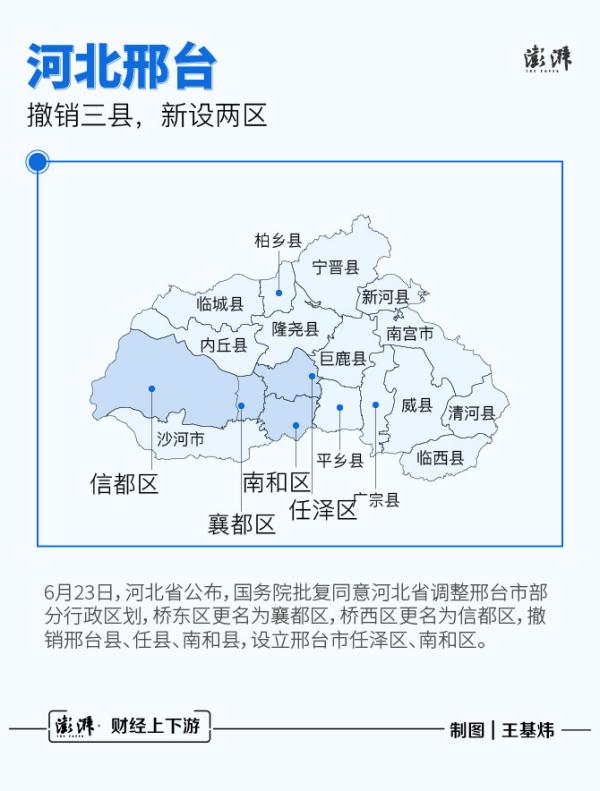
On June 23, Hebei Province announced that the State Council approved Hebei Province to adjust some administrative divisions of Xingtai City. Qiaodong District was renamed Xiangdu District and qiaoxi district was renamed Xindu District. Revoke Xingtai County, and the township streets of Xingtai County were placed under the jurisdiction of Xiangdu District and Xindu District respectively; Revoke Renxian County and establish Renze District of Xingtai City; Nanhe County was abolished and Nanhe District of Xingtai City was established.
This time, Xingtai City cancelled three counties and set up two new districts in one fell swoop, and the adjustment of administrative divisions was quite large. The most obvious change in this expansion is the huge increase in the urban area of Xingtai City. After the adjustment, the urban area of Xingtai will be expanded from 162 square kilometers to 2,945 square kilometers, and the population will increase from 860,000 to 1.95 million.
It is understood that Xingtai City faced the embarrassment of "projects and other land" because the urban area was too small and counted down in Hebei Province. After this zoning adjustment, it will leave enough room for the sustainable construction of the city in the future, and effectively solve the constraints of the land "bottleneck" on the industrialization and urbanization development of Xingtai.
Huangnan Prefecture, Qinghai: Tongren County withdrew from the county to set up a city.
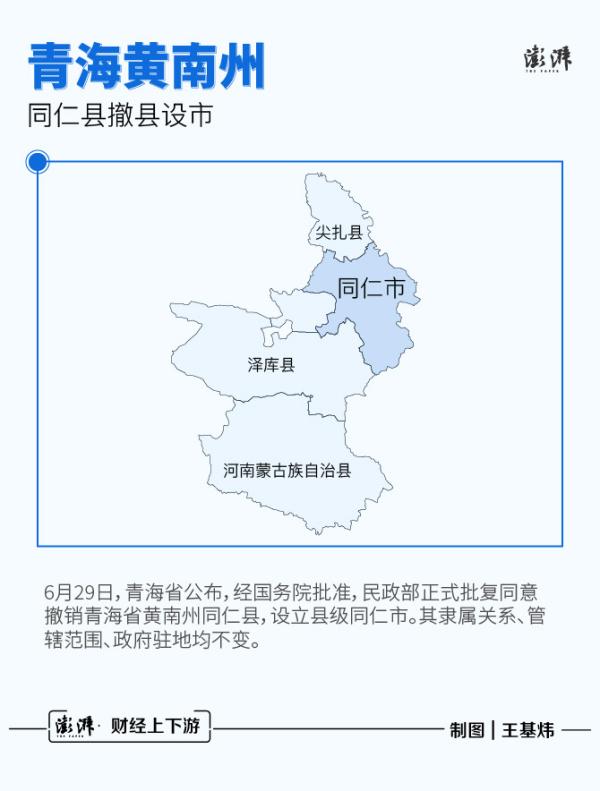
On June 29th, Qinghai Province announced that with the approval of the State Council, the Ministry of Civil Affairs officially approved to cancel Tongren County in Huangnan Tibetan Autonomous Prefecture of Qinghai Province and set up Tongren City at the county level. Its affiliation, jurisdiction and government residence remain unchanged.
After Tongren County was removed from the county to set up a city, the administrative division of Huangnan Prefecture changed from the original four counties to one city and three counties.
Tongren County is located in the intersection of Qinghai, Gansu and Sichuan provinces. It is the residence of Huangnan Prefecture, the core area of national Regong cultural and ecological protection zone, and the only national historical and cultural city in Qinghai Province. The Regong Art and Huangnan Tibetan Opera originated here are listed in the representative list of human intangible cultural heritage.
Qinghai Province said that the withdrawal of Tongren County from the county to set up a city is an important measure to promote the development of the western region to form a new pattern, the construction of Lanxi urban agglomeration and other national strategies, and to deeply integrate into the "Belt and Road".
Ganzhou, Jiangxi Province: longnan county withdrew its county and set up a city.
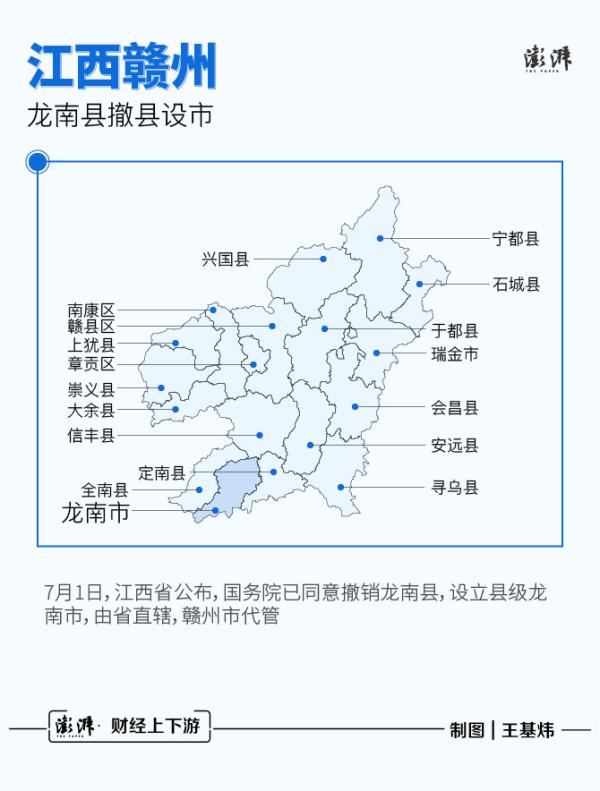
On July 1st, Jiangxi Province announced that the State Council had agreed to cancel longnan county and set up Longnan City at the county level, which was directly under the jurisdiction of the province and managed by Ganzhou City.
Longnan, located at the southernmost tip of Jiangxi Province, is known as the "South Gate of Jiangxi". After the newly established county-level Longnan City became Ruijin, the "red old capital", it was the second county-level city managed by Ganzhou.
According to Jiangxi media reports, from the map, Longnan, located in the southwest of Ganzhou, and Ruijin, previously located in the northeast, together with the urban area in the northwest of Ganzhou, just constitute the "development triangle" of Ganzhou City.
Longnan and Ruijin are located at the left and right ends of Ganzhou city respectively, and they are more adjacent to the surrounding provinces — — Longnan is adjacent to Guangdong Province, while Ruijin is adjacent to Fujian Province, which is beneficial to stimulating investment and attracting talents.
Jingzhou, Hubei Province: Jianli County withdrew from the county to set up a city.
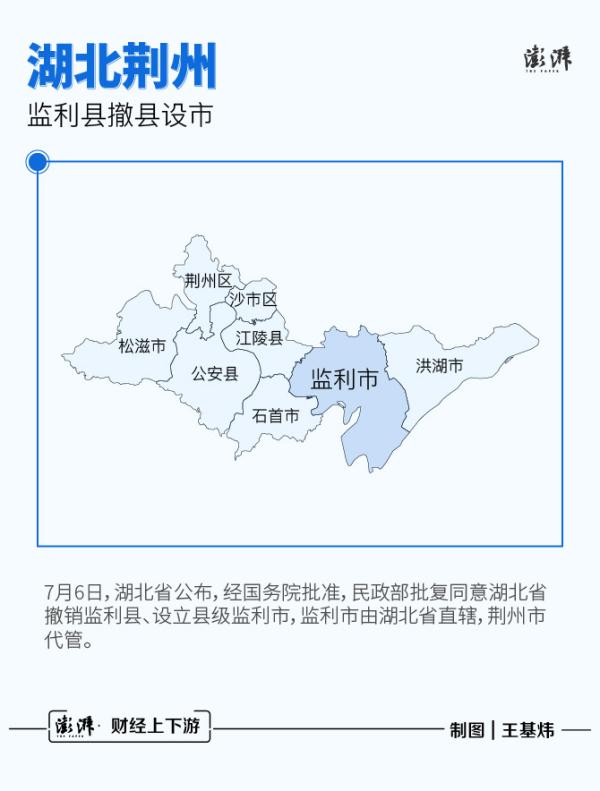
On July 6th, Hubei Province announced that, with the approval of the State Council, the Ministry of Civil Affairs approved the cancellation of Jianli County and the establishment of Jianli City at the county level in Hubei Province. Jianli City was directly under the jurisdiction of Hubei Province, and Jingzhou City was in charge.
Jianli is located in the south-central part of Hubei Province, at the southern end of Jianghan Plain and north of Dongting Lake. Its geographical position is special, not only in the strategic construction area of the national Yangtze River Economic Belt and the urban agglomeration in the middle reaches of the Yangtze River, but also in the "intersection area" of Dongting Lake Ecological Economic Zone and the Yangtze River Economic Belt, and the "radiation area" of Wuhan City Circle and Changsha-Zhuzhou-Xiangtan City Circle.
In addition, Jianli is also the "first county of crayfish in China", with a total area of 1.08 million mu of shrimp and rice. In 2019, the output of crayfish was 150,000 tons, ranking first in the country.
It is worth noting that on July 3, Jianli just welcomed a "post-80 s" doctoral county party secretary. On the morning of July 3rd, Jianli held a meeting of leading cadres to convey the notice of the provincial party committee and the municipal party committee on the appointment of Comrade Han Xu as the secretary of the CPC Jianli County Committee, with the term of office starting from June 19th, 2020.
The public resume shows that Han Xu, male, Han nationality, born in Dengzhou, Henan Province, was born in January 1982, joined the work in July 2008, and joined the Communist Party of China (CPC) in June 2006 with a doctorate. Han Xu studied physical chemistry (including chemical physics) at China University of Science and Technology in his early years.
Wuhu, Anhui: Wuhu County and Fanchang County are divided into districts.
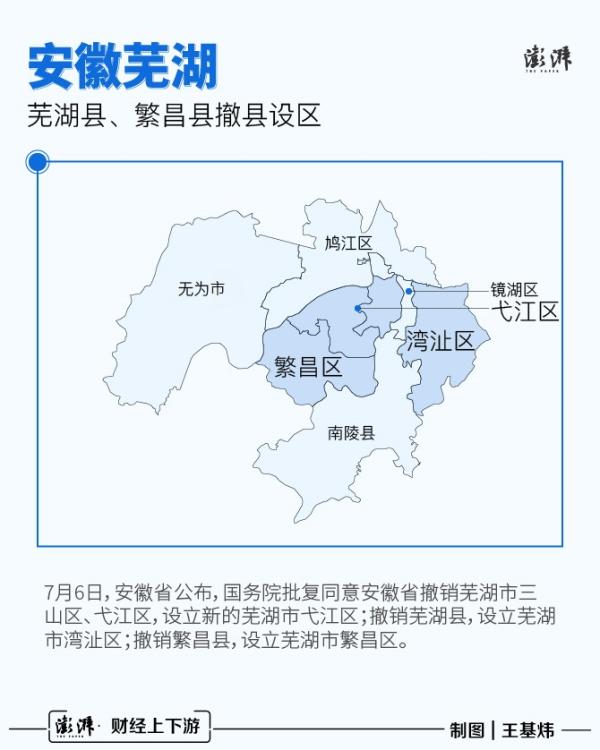
On July 6, Anhui Province announced that the State Council approved Anhui Province to cancel sanshan district and Yijiang District of Wuhu City and set up a new yijiang district; Cancel Wuhu County and establish Wuhu Bay Area; Fanchang County was abolished and Fanchang District of Wuhu City was established.
After this zoning adjustment, the jurisdiction of Wuhu City has been adjusted from the original 4 districts, 3 counties and 1 city to 5 districts, 1 county and 1 city (Jinghu District, Yijiang District, Jiujiang District, Bay Area, Fanchang District, Nanling County and Wuwei City).
In an interview with the local media, the person in charge of the relevant departments of the Anhui Provincial Civil Affairs Department said that the relocation of Wuhu County and Fanchang County into districts through zoning adjustment will play a very important role in further building the status of Wuhu as a regional central city, promoting the development of urban agglomerations in the Yangtze River Delta and the higher quality integrated development of the Yangtze River Delta.
The person in charge said that in recent years, the economic strength of Wuhu County and Fanchang County has been significantly enhanced, and the economic and social ties with the downtown area of Wuhu have become increasingly close. Residents’ commuting, communication, inter-district residence and employment consumption have become increasingly frequent, and the economy, transportation and urban facilities have gradually integrated with the downtown area. In this context, the withdrawal of counties from two counties to set up districts is conducive to breaking down the barriers of urban-rural integration, expanding the absorption of surrounding people into cities for employment, and promoting the urbanization of agricultural transfer population nearby.