This round of administrative division adjustment inventory: five cities expand, and three cities set up cities from counties.

  Since June this year, the curtain of administrative division adjustment in 2020 has been opened. According to the statistics of The Paper, as of press time, five cities, including Chengdu, Changchun, Yantai, Xingtai and Wuhu, have completed expansion, and three counties, including Tongren County in Qinghai, longnan county County in Jiangxi and Wuhu County in Anhui, have completed the withdrawal of counties and the establishment of cities.

  The so-called "urban expansion" is generally completed by "removing counties and setting up districts", that is, transforming counties or county-level cities into municipal districts, so that previously relatively independent counties can be brought under the jurisdiction of cities and develop as a whole.

  The so-called "removing counties to set up cities" refers to turning counties into county-level cities, aiming at promoting new urbanization and promoting the urbanization of agricultural transfer population in situ and nearby.

  Judging from the cities expanded this time, Chengdu, Sichuan and Changchun, Jilin are both provincial capitals, Wuhu ranks second in GDP in Anhui Province, and Yantai ranks third in GDP in Shandong Province. It can be seen that "removing counties and setting up districts" is generally a measure when the city develops to a certain stage and the next step of development and construction is facing constraints. For example, in 2001, Hangzhou announced the abolition of Xiaoshan City and Yuhang City and the establishment of Xiaoshan and Yuhang Districts.

  Lin Tuo, a professor at the School of Urban and Regional Sciences of East China Normal University, told The Paper (www.thepaper.cn) that the above-mentioned series of urban expansion actions are aimed at making advantageous areas have more room for development and enhancing the comprehensive carrying capacity and optimal allocation of resources.

  Chengdu, Sichuan: Xinjin County is divided into districts.
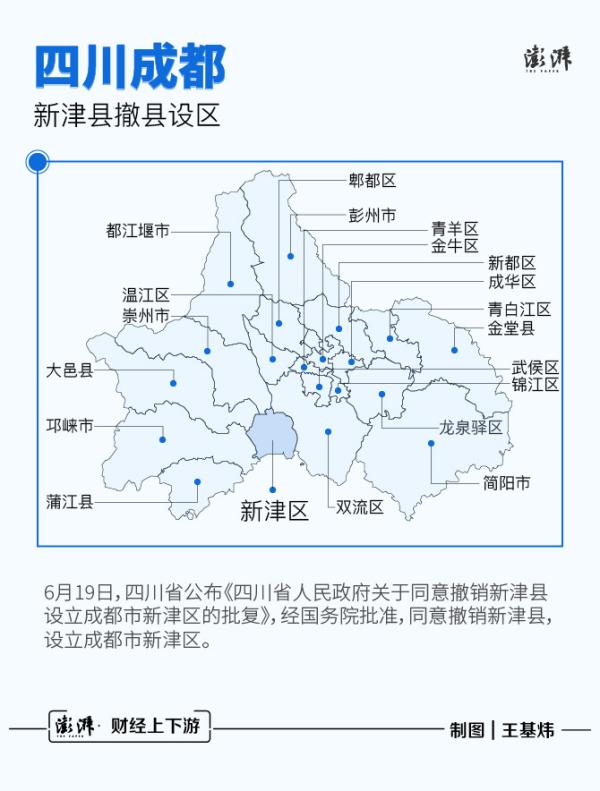
  On June 19th, Sichuan Province announced the Reply of Sichuan Provincial People’s Government on Agreeing to Cancel Xinjin County and Establish Xinjin District in Chengdu. With the approval of the State Council, it agreed to cancel Xinjin County and establish Xinjin District in Chengdu. On June 30th, Xinjin District of Chengdu was officially listed.

  The Sichuan Civil Affairs Department said that the establishment of Xinjin District in Chengdu is conducive to optimizing the spatial structure of Chengdu, enhancing the comprehensive carrying capacity and resource allocation capacity of the central city, and improving its radiation-driven role; It is conducive to accelerating the construction of the twin-city economic circle in Chengdu-Chongqing area and forming an important growth pole for high-quality development in the west; It is conducive to the in-depth implementation of the new urbanization strategy and the development strategy of "one stem and many branches" to promote the high-quality development of Sichuan Province; It is conducive to Chengdu to practice the new development concept, build a park city demonstration area, improve the quality of urban functions, and promote the modernization of the governance system and governance capacity of megacities.

  Changchun, Jilin: Gongzhuling City is placed under the custody of Changchun City.
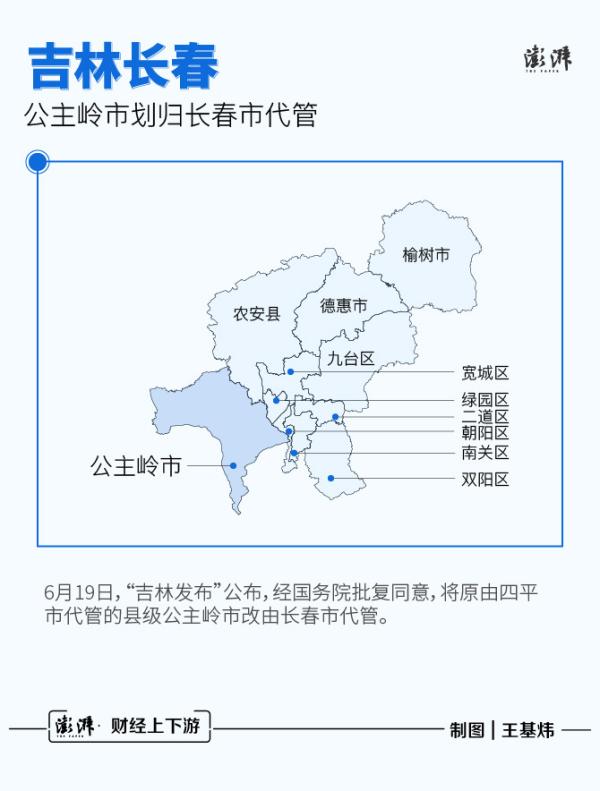
  On June 19th, Jilin Province announced that with the approval of the State Council, the county-level Gongzhuling City, which was originally hosted by Siping City, will be hosted by Changchun City.

  Bayin Chaolu, secretary of the Jilin Provincial Party Committee, said at the "Working Meeting on Changing the Hosting Relationship of Gongzhuling City" that it is necessary to take the opportunity of changing the hosting relationship of Gongzhuling City and adjusting administrative divisions to comprehensively promote the coordinated development of the urbanization of Gongzhuling in Changchun, accelerate the cultivation and make every effort to build a modern metropolitan area in Changchun, and promote the development of central urban agglomerations and central innovation and transformation core areas.

  Bayin Chaolu also stressed that it is necessary to speed up the construction of "Great Changchun" through the coordinated development of Gongzhuling in Changchun, and strive to build Changchun into a core city of Harbin-Changzhou urban agglomeration and an international automobile city with international influence, effectively enhance its position in the whole Northeast plate, enhance its core competitiveness, and further highlight Changchun’s location advantage in the center of Northeast China.

  Yantai, Shandong Province: Penglai City and Changdao County were abolished and Penglai District was established.
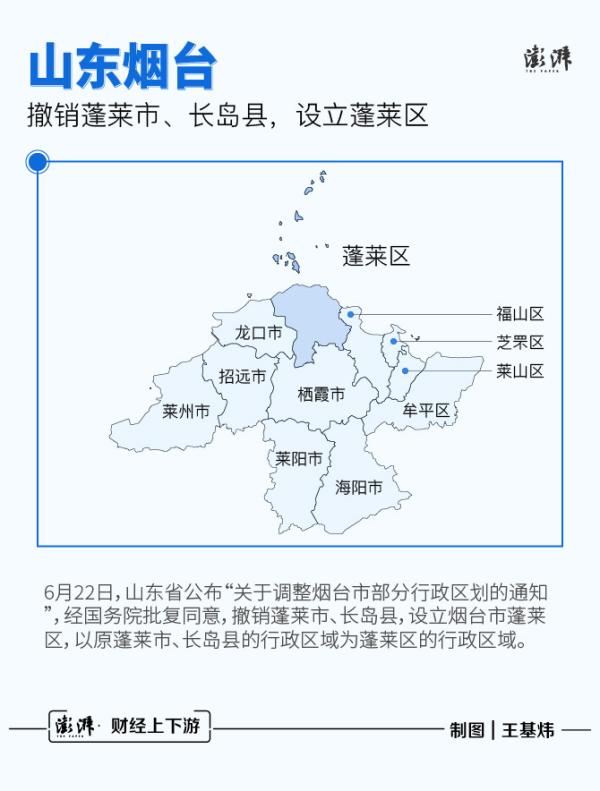
  On June 22nd, Shandong Province announced the "Notice on Adjusting Some Administrative Divisions of Yantai City". With the approval of the State Council, Penglai City and Changdao County were abolished, and Penglai District of Yantai City was established, with the original administrative areas of Penglai City and Changdao County as the administrative areas of Penglai District.

  The Paper (www.thepaper.cn) reporter noted that Long Island and Penglai play an extremely important role in Yantai’s future traffic planning and layout. In the planning of Bohai Bay cross-sea passage connecting Yantai, Shandong and Dalian, Liaoning, the starting point of Shandong side is Penglai-Long Island.

  At this year’s two sessions of the National People’s Congress, Zhang Shuping, deputy to the National People’s Congress and secretary of Yantai Municipal Party Committee, suggested speeding up the construction of a direct express passage across the Bohai Strait to solve the land-sea connection problem between Shandong Peninsula and Liaodong Peninsula.

  According to Shandong media reports, Penglai District of Yantai City will be officially listed in early September.

  Xingtai, Hebei Province: Three counties were abolished and two districts were established.
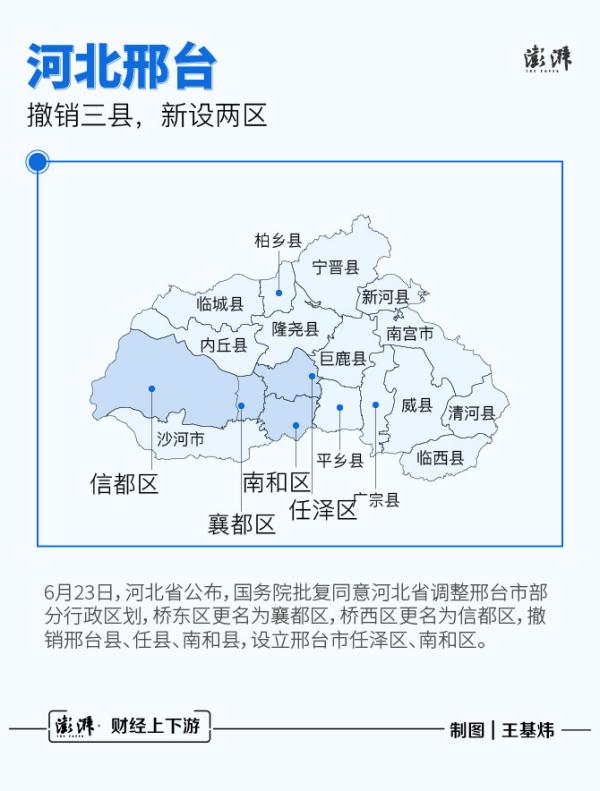
  On June 23, Hebei Province announced that the State Council approved Hebei Province to adjust some administrative divisions of Xingtai City. Qiaodong District was renamed Xiangdu District and qiaoxi district was renamed Xindu District. Revoke Xingtai County, and the township streets of Xingtai County were placed under the jurisdiction of Xiangdu District and Xindu District respectively; Revoke Renxian County and establish Renze District of Xingtai City; Nanhe County was abolished and Nanhe District of Xingtai City was established.

  This time, Xingtai City cancelled three counties and set up two new districts in one fell swoop, and the adjustment of administrative divisions was quite large. The most obvious change in this expansion is the huge increase in the urban area of Xingtai City. After the adjustment, the urban area of Xingtai will be expanded from 162 square kilometers to 2,945 square kilometers, and the population will increase from 860,000 to 1.95 million.

  It is understood that Xingtai City faced the embarrassment of "projects and other land" because the urban area was too small and counted down in Hebei Province. After this zoning adjustment, it will leave enough room for the sustainable construction of the city in the future, and effectively solve the constraints of the land "bottleneck" on the industrialization and urbanization development of Xingtai.

  Huangnan Prefecture, Qinghai: Tongren County withdrew from the county to set up a city.
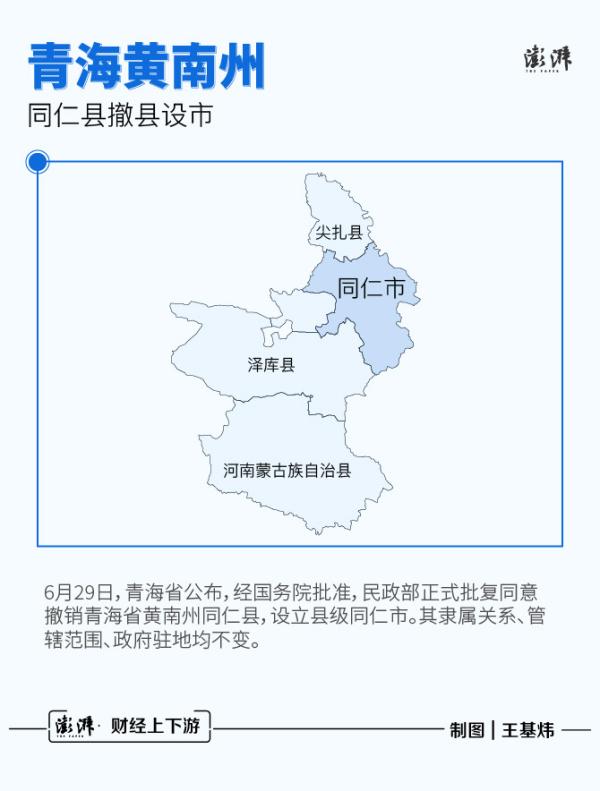
  On June 29th, Qinghai Province announced that with the approval of the State Council, the Ministry of Civil Affairs officially approved to cancel Tongren County in Huangnan Tibetan Autonomous Prefecture of Qinghai Province and set up Tongren City at the county level. Its affiliation, jurisdiction and government residence remain unchanged.

  After Tongren County was removed from the county to set up a city, the administrative division of Huangnan Prefecture changed from the original four counties to one city and three counties.

  Tongren County is located in the intersection of Qinghai, Gansu and Sichuan provinces. It is the residence of Huangnan Prefecture, the core area of national Regong cultural and ecological protection zone, and the only national historical and cultural city in Qinghai Province. The Regong Art and Huangnan Tibetan Opera originated here are listed in the representative list of human intangible cultural heritage.

  Qinghai Province said that the withdrawal of Tongren County from the county to set up a city is an important measure to promote the development of the western region to form a new pattern, the construction of Lanxi urban agglomeration and other national strategies, and to deeply integrate into the "Belt and Road".

  Ganzhou, Jiangxi Province: longnan county withdrew its county and set up a city.
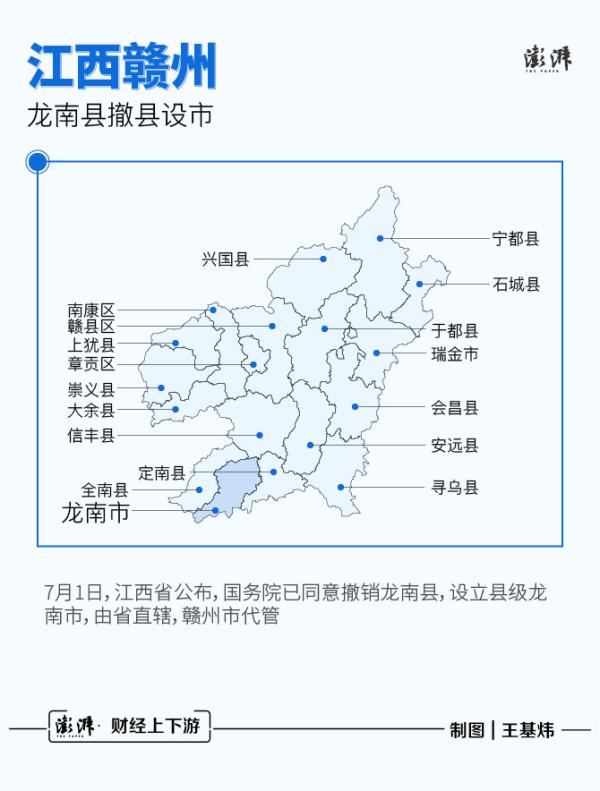
  On July 1st, Jiangxi Province announced that the State Council had agreed to cancel longnan county and set up Longnan City at the county level, which was directly under the jurisdiction of the province and managed by Ganzhou City.

  Longnan, located at the southernmost tip of Jiangxi Province, is known as the "South Gate of Jiangxi". After the newly established county-level Longnan City became Ruijin, the "red old capital", it was the second county-level city managed by Ganzhou.

  According to Jiangxi media reports, from the map, Longnan, located in the southwest of Ganzhou, and Ruijin, previously located in the northeast, together with the urban area in the northwest of Ganzhou, just constitute the "development triangle" of Ganzhou City.

  Longnan and Ruijin are located at the left and right ends of Ganzhou city respectively, and they are more adjacent to the surrounding provinces — — Longnan is adjacent to Guangdong Province, while Ruijin is adjacent to Fujian Province, which is beneficial to stimulating investment and attracting talents.

  Jingzhou, Hubei Province: Jianli County withdrew from the county to set up a city.
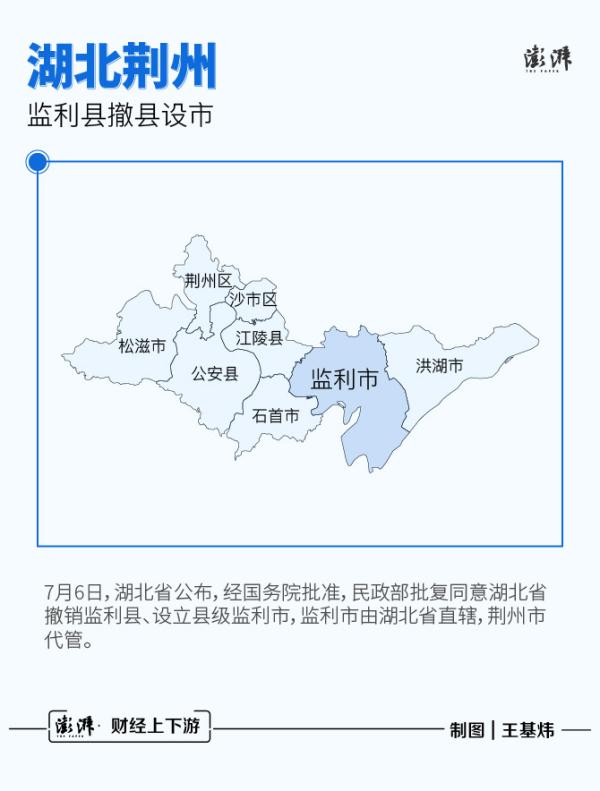
  On July 6th, Hubei Province announced that, with the approval of the State Council, the Ministry of Civil Affairs approved the cancellation of Jianli County and the establishment of Jianli City at the county level in Hubei Province. Jianli City was directly under the jurisdiction of Hubei Province, and Jingzhou City was in charge.

  Jianli is located in the south-central part of Hubei Province, at the southern end of Jianghan Plain and north of Dongting Lake. Its geographical position is special, not only in the strategic construction area of the national Yangtze River Economic Belt and the urban agglomeration in the middle reaches of the Yangtze River, but also in the "intersection area" of Dongting Lake Ecological Economic Zone and the Yangtze River Economic Belt, and the "radiation area" of Wuhan City Circle and Changsha-Zhuzhou-Xiangtan City Circle.

  In addition, Jianli is also the "first county of crayfish in China", with a total area of 1.08 million mu of shrimp and rice. In 2019, the output of crayfish was 150,000 tons, ranking first in the country.

  It is worth noting that on July 3, Jianli just welcomed a "post-80 s" doctoral county party secretary. On the morning of July 3rd, Jianli held a meeting of leading cadres to convey the notice of the provincial party committee and the municipal party committee on the appointment of Comrade Han Xu as the secretary of the CPC Jianli County Committee, with the term of office starting from June 19th, 2020.

  The public resume shows that Han Xu, male, Han nationality, born in Dengzhou, Henan Province, was born in January 1982, joined the work in July 2008, and joined the Communist Party of China (CPC) in June 2006 with a doctorate. Han Xu studied physical chemistry (including chemical physics) at China University of Science and Technology in his early years.

  Wuhu, Anhui: Wuhu County and Fanchang County are divided into districts.
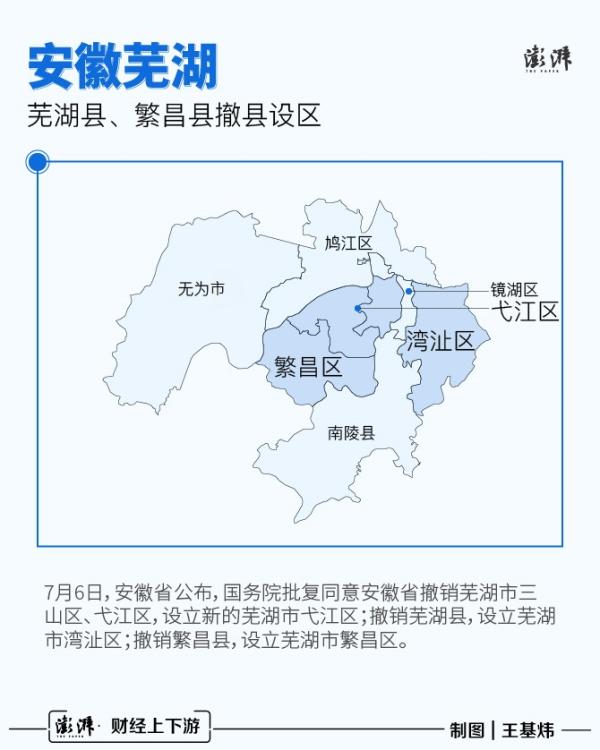
  On July 6, Anhui Province announced that the State Council approved Anhui Province to cancel sanshan district and Yijiang District of Wuhu City and set up a new yijiang district; Cancel Wuhu County and establish Wuhu Bay Area; Fanchang County was abolished and Fanchang District of Wuhu City was established.

  After this zoning adjustment, the jurisdiction of Wuhu City has been adjusted from the original 4 districts, 3 counties and 1 city to 5 districts, 1 county and 1 city (Jinghu District, Yijiang District, Jiujiang District, Bay Area, Fanchang District, Nanling County and Wuwei City).

  In an interview with the local media, the person in charge of the relevant departments of the Anhui Provincial Civil Affairs Department said that the relocation of Wuhu County and Fanchang County into districts through zoning adjustment will play a very important role in further building the status of Wuhu as a regional central city, promoting the development of urban agglomerations in the Yangtze River Delta and the higher quality integrated development of the Yangtze River Delta.

  The person in charge said that in recent years, the economic strength of Wuhu County and Fanchang County has been significantly enhanced, and the economic and social ties with the downtown area of Wuhu have become increasingly close. Residents’ commuting, communication, inter-district residence and employment consumption have become increasingly frequent, and the economy, transportation and urban facilities have gradually integrated with the downtown area. In this context, the withdrawal of counties from two counties to set up districts is conducive to breaking down the barriers of urban-rural integration, expanding the absorption of surrounding people into cities for employment, and promoting the urbanization of agricultural transfer population nearby.
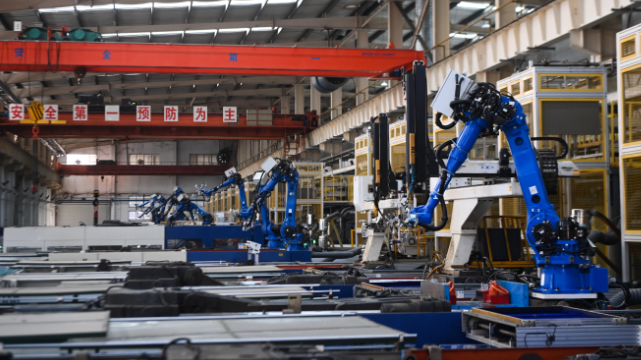
"Burning money" is difficult to make a profit in five years. Where is the difficulty in the digital transformation of manufacturing enterprises?

  "I have invested for five years and hope to reach a profit balance point next year." Chloe Wang, director and general manager of Hefei Heforging Intelligent Manufacturing Co., Ltd., said in an interview with CBN.

  As an equipment manufacturing enterprise founded in 1951, Heforging Intelligent has been digitally upgraded based on the industrial Internet platform since 2017. "Digital transformation can improve production efficiency, but the premise is that it needs to be continuously ‘ Burning money ’ This is undoubtedly a huge sum of money for equipment manufacturing enterprises that originally invested heavily in assets. From ‘ Digital upgrade ’ Judging from the return on investment of the project, we have not made any profit in the past few years. Ideally, it will still take 2 to 3 years of layout and become a new profit growth point. " Chloe Wang said.

  This is not only an individual story that happened in a traditional manufacturing enterprise, but also a microcosm of the digital transformation of domestic manufacturing enterprises in recent years.

  China’s manufacturing industry has been ranked first in the world for many years, but the overall level of informatization is still not high, and the integration with industrialization is not deep enough. The digitalization of manufacturing enterprises, especially small and medium-sized manufacturing enterprises, is still in its early stage. At the beginning of November, the General Office of the Ministry of Industry and Information Technology issued the Notice on Printing and Distributing the Guidelines for the Digital Transformation of Small and Medium-sized Enterprises, proposing the idea of "from easy to difficult, from point to surface, long-term iteration and multi-party collaboration" for small and medium-sized enterprises, and proposing "promoting business collaboration, resource integration and data sharing of upstream and downstream enterprises in the industrial chain supply chain to help small and medium-sized enterprises realize ‘ Chain ’ Transformation "requirements.

  The "small and medium-sized enterprises" here are interpreted by the Information Technology Development Department of the Ministry of Industry and Information Technology, especially the manufacturing small and medium-sized enterprises.

  According to a recent survey released by iResearch, the digital transformation of manufacturing enterprises in China is still dominated by central state-owned enterprises and large-scale private enterprises, and the demand amount is concentrated between 1 million and 5 million. The overall project cycle lasts about 4 to 18 months, which has the characteristics of high amount and long duration.

  Under the tug-of-war of multiple factors such as "demand vs cost vs effect", many people in the industry interviewed told reporters that for small and medium-sized manufacturing enterprises, especially those in traditional heavy asset industries such as equipment manufacturing, how to achieve sustainability in digital transformation is still a difficult problem to be solved.

  Is digitalization a "compulsory course"

  "Digitalization is not an end." Chloe Wang said that the digital transformation of manufacturing industry in an ideal state is a means to reduce costs, increase efficiency and expand new business models.

  He believes that the transformation includes two aspects: one is the digital transformation of the whole cycle from production to sales within the enterprise, and the other is to enhance the value of the data loaded by the product. The former aims to improve quality and efficiency, while the latter aims to increase the market competitiveness and customer stickiness of products by optimizing the sense of product use, and finally help enterprises realize the transformation from island type to user experience type.

  "For industry enterprises, it is still a question mark whether digital investment is just needed and to what extent digitalization can bring the greatest value to enterprises. If the transformation is carried out, SMEs will also face a problem: as the head enterprises have implemented the full-cycle digital integration innovation with the help of information means such as industrial Internet and big data platform, if they continue to rely on the digital transformation of a single link, the marginal utility of SMEs to obtain digital dividends will be weakened. " Chloe Wang said.

  Multiple factors are superimposed, is the motivation for the transformation of SMEs sufficient? This problem once troubled Zhang Youming, general manager of UFIDA Jingzhi Industrial Internet Division. However, after attending the training activities of the digital transformation of small and medium-sized entrepreneurs in the Industrial Culture Center of the Ministry of Industry and Information Technology as a lecturer, he had a more positive answer to this question: "Within one week after the meeting, many students contacted me actively, and some of them later became our customers. Many of these students were at the helm of small and medium-sized equipment manufacturing enterprises."

  Zhang Youming told CBN that the informatization foundation of such enterprises has been weak. "The automobile and process manufacturing industries have high requirements for refined management level and automation level of key machines needed for continuous production, so the digital progress of the industry can be promoted quickly."

  In contrast, the equipment manufacturing industry has "walked slowly" in the digital transformation. Zhang Youming believes that this is caused by multiple factors. First, as an industry with heavy investment in assets, if the equipment manufacturing industry iterates intelligent products for large equipment in the production process, the transformation cost will be even higher; Secondly, as a traditional manufacturing industry, the equipment manufacturing industry is relatively extensive, with low profit margin, and the motivation of small and medium-sized enterprises to apply new technologies is limited. In addition, the supply chain and industrial chain of the equipment manufacturing industry have been relatively fixed, and the space for business expansion is relatively limited after enterprises "go to the cloud".

  "Positive factors are increasing." Zhang Youming believes that at present, with the upgrading of downstream demand, the strength of customized production capacity has directly affected the competitiveness of equipment manufacturing enterprises, and this mode of collaborative management while designing and producing is difficult, making digitalization gradually become an urgent need for enterprises.

  "Complex products and many spare parts are the industry characteristics of the equipment manufacturing industry, and small and medium-sized enterprises are no exception. With the increase of upstream parts manufacturers in the industry, whether we can find suppliers with better cost performance and whether the supply channels are smooth is directly related to the production and sales of enterprises. To solve the synergy problem of this kind of all-factor industrial chain, it is necessary to build an industrial Internet platform. " Zhang Youming said.

  According to Zhang Youming, the industrial Internet can help small and medium-sized enterprises get through the upstream and downstream of the supply chain, reduce their raw material costs, and increase their ability to seize business opportunities and market bargaining power by receiving more downstream customers. In addition, after enterprises go to the cloud platform, production, R&D and sales are all digital. This way of "converting traditional assets into industrial data and then converting data into credit" also provides a solution to the financing problem of SMEs.

  Integrate into digital ecology

  "I have contacted many small and medium-sized manufacturing enterprises, and almost no business decision makers don’t know about the industrial Internet, but few can really tell what the industrial Internet architecture is? What are the business software of enterprise operation management adapted to the big data ecological environment? What business does the enterprise need ‘ Shangyun ’ ?” A person in charge of business related to enterprise cloud services and software providers told reporters.

  At the beginning of November, the Ministry of Industry and Information Technology issued the Evaluation Table of Digitalization Level of Manufacturing SMEs (2022 Edition). On the index of "Digitalization Basis", 20% of the weight is "Enterprises realize digital management of business by deploying industrial Internet public cloud/private cloud/hybrid cloud platform".

  Daniel He, co-founder and CEO of Shugen Internet, told CBN that "Industrial Internet" has many extensions, including automatic equipment sensors, 5G communication solutions and many industrial solutions, but its real core is these operating systems or industrial Internet platforms. "With the head manufacturing enterprises taking the initiative to build an industry-level industrial Internet platform, it is convenient for SMEs to catch up with the digital transformation of the industry."

  It is also mentioned in the Guide to Digital Transformation of Small and Medium-sized Enterprises that small and medium-sized enterprises should integrate into the digital ecology. Apply the industrial internet platform built by the core enterprises in the industrial chain and supply chain, integrate into the core enterprise ecosystem, strengthen cooperation and support, and realize the coordinated transformation of large, medium and small enterprises. Apply the common solutions exported by leading enterprises in the industry to accelerate the improvement of their digital level.

  According to the guide, in addition to the leading enterprises in the industry, the service providers of digital transformation of small and medium-sized enterprises also include Internet platform enterprises, industrial Internet platform enterprises and digital transformation service providers.

  According to the data of the Ministry of Industry and Information Technology, as of the third quarter of 2022, the industrial Internet has been fully integrated into 45 categories of national economy, and more than 150 characteristic platforms with certain industry and regional influence have been cultivated, and 28 cross-industry and cross-domain industrial Internet platforms have been selected, among which 32 key platforms have more than 79 million sets of connecting equipment and more than 280,000 industrial apps.

  Faced with more and more regional, industry and enterprise industrial Internet platforms, the choice and bargaining power of small and medium-sized manufacturing enterprises in digital investment began to increase. However, new problems follow: how can SMEs "get on the platform" with lower threshold and lower cost?

  "There are three main concerns of SMEs: first, applications that can generate value, second, affordable, and third, low barriers, that is, not many IT engineers know how to use them." Daniel He said that on the supply side, in view of the characteristics and actual needs of small and medium-sized enterprises, digital transformation service providers have begun to provide lightweight and subscription services to alleviate the concerns and costs of digital transformation of small and medium-sized enterprises.

  The so-called "subscription service", Daniel He said, is to deposit all kinds of industrial best practices on this industrial Internet platform, and then let SMEs directly subscribe to these industrial application apps.

  According to Zhang Youming’s observation, the choices of small and medium-sized enterprises are often diversified. They can choose to share the platform with chain-length enterprises, or they can choose to rent, buy the industrial Internet platform built by third-party cloud service providers in one time or in stages.

  Daniel He believes that the industrial Internet is a huge ecology and system. From the perspective of input cost and time, even small and medium-sized manufacturing enterprises with abundant cash flow need to carefully consider building their own industrial Internet platform.

  "If every enterprise does its own common platform at the bottom, on the one hand, it will spend a lot of money, spend a lot of time and need a lot of talents; On the other hand, in terms of application scale, it is actually amortization for enterprises. " Daniel He said.

  Two Challenges of Sustainable Transformation

  Traditional manufacturing enterprises are forced to digitize, and the rising labor cost is one of the major reasons. However, some interviewees told reporters that after the transformation, the employment cost of some small and medium-sized manufacturing enterprises has increased instead of falling.

  "The rising labor costs in manufacturing really reflect the shortage of talents." Daniel He said.

  Zhang Youming said that on the one hand, the industrial Internet needs compound talents who know both industry and digital technology, and are also very innovative. This kind of talent training cycle is very long. The Ministry of Education added the major of industrial Internet application in 2021, that is to say, before that, the social supply of industrial Internet talents could only be cultivated by enterprises; On the other hand, if a manufacturing enterprise does not set up a science and technology company, it will not be able to recruit and retain digital talents according to its original salary system, and even cultivate the digital team of the enterprise, but this will undoubtedly not work for small and medium-sized manufacturing enterprises in the short term.

  In response to the challenge of insufficient information professionals’ reserve, the strategy adopted by Hezhengzhizao is to invite "foreign aid". Chloe Wang said that up to now, the technology companies that the company has cooperated or invested abroad include Iflytek and Anhui Sanheyi Information Technology Co., Ltd..

  In the long run, there are two ways to solve the talent gap problem in the digital transformation of manufacturing industry. Sunny Li, the Industrial Internet Research Office of CCID Research Institute, told CBN that on the one hand, it is necessary to give full play to the role of industry alliances and organizations as a bridge, and focus on technical shortcomings such as hardware foundation, industrial software, data transmission, and industrial control security in order to meet the needs of manufacturing applications. Jointly tackle a number of common key technologies; On the other hand, IT is necessary to deepen the cooperation between production and education, establish a joint training mechanism of "enterprise+university", and directionally transport a group of compound talents who know both IT and OT to the manufacturing industry.

  Not only is there a shortage of people, Chloe Wang said that data is the key value of intelligent manufacturing products. However, at present, the downstream customers’ recognition and utilization rate of digital application of products are not high, the added value of products is difficult to show, and the R&D investment of manufacturing enterprises cannot form positive feedback, which also makes some small and medium-sized manufacturing enterprises lose the motivation of transformation.

  Just like the downstream customers of aerospace and military industries have high requirements for the digital application of high-end intelligent manufacturing, in practice, Chloe Wang found that the needs of these customers have little benefit for intelligent manufacturing enterprises. "At present, downstream industries with high demand for digital applications of products are often industries with higher demand for data security and privacy protection. This has led to the need for manufacturing companies to sign confidentiality agreements when serving customers in such industries, and to share data point to point, making it difficult to maximize the value of data. "

  Chloe Wang appealed that if the digital transformation of manufacturing enterprises is sustainable, it is necessary to build a more mature data factor market, so as to promote manufacturing enterprises to rebuild their competitive advantages through digital transformation.

No homework for 34 years! Three principals relay "efficient classroom"

  Is there a contradiction between not leaving homework and improving grades? The Fifth Primary School of Shenyang Railway has given an almost perfect answer with 34 years’ practice.

  When many parents are anxious to accompany their children to do homework after class, the three principals of this primary school insist on not leaving written homework for 34 years, and carry out the experiment of happy education reform, so that students can effectively integrate into learning under the guidance of interest and reduce the burden and improve the quality under the concept of happy education.

  Ask for quality in a 40-minute class

  "Only teachers who don’t understand, no children who can’t learn. There are so many knowledge points that there is no need to leave homework and practice repeatedly. " Zhang Xiujin, the old headmaster, said.

  Railway five primary schools do not leave written homework, which originated in 1984. At that time, the students had a heavy burden, so Zhang Xiujin, then the principal, decided to reduce the burden in the whole school and started a pilot class first. The method is simple: be effective in the classroom, increase the interaction between teachers and students, and mobilize the enthusiasm of students. After half a year, the results of the pilot class are significantly higher than those of other classes. Since then, no homework has been left in the whole school from grade one to grade six.

  "Efficient classroom" is a high-frequency word mentioned by teachers in the interview. "The sea tactics is a misunderstanding. Teachers should concentrate the most essential knowledge points in the classroom so that students can draw inferences from one another." Yu Ying, the current principal, said that teachers should ensure that all the knowledge learned by students in every class, every day and every stage can be absorbed and digested in the classroom. This is called the "three cleanups" system.

  In order to realize the "Three Clearances", in Railway No.5 Primary School, teachers spend a lot of energy on preparing lessons and teaching exchanges to ensure the high quality of teaching. After Yu Miao, a fifth-grade teacher, came to Railway No.5 Primary School, all school leaders attended the class collectively, giving her suggestions and guiding the improvement of classroom teaching. In 2017, she won the title of senior Chinese subject in the "Evaluation of Good Classroom Teaching in Heping District".

  In order to improve students’ ability to study efficiently, the school offers a 15-minute mini-training course every afternoon. From writing and memorizing in a limited time in junior grades to arranging and communicating mind maps in senior grades, students’ abilities of memorizing, listening and summarizing are greatly improved, and their thinking quality is greatly improved.

  In the past 34 years, the tradition of not leaving written homework has been preserved. For Yu Ying, the current principal, the pressure to insist on not leaving homework has only increased over the years: although the junior high school has been cancelled, the pressure to enter a higher school has moved forward, parents have higher expectations for their children, and the difficulty of various exams has also been continuously improved. Can the trick of not leaving homework still be used?

  "As long as the educational concept is correct and you have the determination to stick to it, ‘ Independent and efficient ’ If the classroom teaching is realized, there is no need for homework. " Yu Ying, who has been a teacher for 26 years since she joined the work, explored the educational idea that "students are the future", and made the school’s educational strategy and action plan with cultivating students’ core literacy and providing appropriate education for children as the core concept.

  Today, there are 67 classes and more than 3,100 students in three campuses of Railway Five Primary Schools, and all of them still insist on leaving no written homework.

  What do students do after school?

  There is no written homework after class. What do students do when they go home? And the school doesn’t care at all

  After school, Shi Diance, a fifth and second grader of the railway, did not go home directly, but once again devoted himself to his favorite ice hockey training ground. He has been practicing ice hockey for nearly a year, and he has performed brilliantly in the Liaoning Ice Hockey League. After two hours of training, he turned on the TV at home first, not to watch cartoons, but to watch the news on the hour. Before going to bed, he watched the extracurricular book Magic School Bus recommended by the head teacher for a while.

  In Railway No.5 Primary School, there is no unified written homework, but every child will arrange his life after school according to his own interests and specialties: reading novels, doing handicrafts, practicing calligraphy, and dancing street dance … …

  According to reports, in order to enrich students’ extracurricular activities, Railway Five Primary Schools recommend "books with words" and "books without words". "Books with characters" are traditional books. By recommending books regularly, offering one-hour reading class every week, reading exchange once a month and reading festival once a semester, students’ ability and quality of lifelong reading are cultivated. "Wordless book" is news, which guides students to read newspapers, listen to the radio and pay attention to online news every day, and carries out students’ independent "broadcast", "comment" and "debate" news every morning.

  The school has set up 20 compulsory courses such as intelligent robot, Orff music and digital art, and more than 60 elective clubs such as science and technology, art, fitness, reading club and English club to help children locate themselves and find their own interests. At the same time, further enrich students’ life at school and after class, and prevent them from drowning in the sea of books and mountains.

  Happy education makes students enjoy it endlessly.

  "Everyday Dad", a fourth-grade parent of the fifth grade of the railway, said in the opening message to all parents of freshmen in 2016: "The school is characterized by not leaving homework, reading and broadcasting news. With these characteristics, children’s knowledge and learning efficiency will become unusual."

  Li Jiaxi, a fourth-grade student, had an average academic record, and sometimes she showed hyperactivity, inattention and low learning efficiency in class. Since joining the school maker space club for one year, he has become a core member of the study group and a small star of science and technology. The innovative works he led the team members to study together — — "Portable One-stop Mobile Phone Companion" has been shortlisted for the 2018 Shenyang Youth Science and Technology Innovation Competition.

  Wang Hongliang, a graduate of the school in 2013, is now studying in Liaoning Experimental Middle School. In 2016, he was ranked third in the city with a score of 744 (out of 760) in the senior high school entrance examination. He benefited a lot from his study experience in Railway No.5 Primary School.

  "High school is very stressful and hard. Whenever I encounter difficulties, I always think of the experience of primary school. A large number of books read at that time are still fresh in my memory until now; Watching the news broadcast every morning makes me develop the habit of paying attention to current affairs and politics, which is of great help to the study of politics and other subjects. " Wang Hongliang said, "What impressed me the most was the robot community, which cultivated my hands-on, innovation, spatial thinking and other abilities. Sometimes I don’t need to draw pictures to solve solid geometry problems, so I can see the form built by Lego in primary schools … … The education of Tiewu contains too many things that are useful for growth. It was only when I was in junior high school and high school that I slowly revealed it and let me enjoy it endlessly. "

  Along the way, doubts and doubts were heard in not fade away. However, the five primary schools of the Railway did not change their minds, persisted in exploring new measures for running a happy education, and constantly introduced new curriculum systems such as micro-courses, science and technology courses, research and practice courses, and handed over beautiful transcripts: the quality monitoring of students’ subjects ranked among the best in the whole region, and the achievements in Chinese and English subjects ranked third and fourth among 55 primary schools in the experimental area of the city. In recent five years, they won hundreds of honors in science, technology, art and sports at or above the provincial level.

  President Yu Ying said: "As basic educators, we will continue to inherit and carry forward the ideological essence of pleasant education, actively explore new fields under the conditions of information technology reform, start with students’ learning ability and study habits, and focus on students’ infinite possibilities in the future to improve the quality of life in childhood." (Reporter Wang Ying)

Heilongjiang Province launched a Class IV emergency response to major meteorological disasters (rainstorm and gale).

  Cctv newsAccording to the news of "Heilongjiang Government Affairs" WeChat WeChat official account, according to the forecast of Heilongjiang Meteorological Observatory, there was a rainfall process from west to east in Heilongjiang Province on August 7, with short-term heavy rainfall in the central and eastern regions, strong locality and uneven rainfall distribution, and the maximum hourly rainfall intensity could reach 40 ~ 60 mm. The accumulated rainfall in southern Yichun, eastern Suihua and Harbin is 50-70 mm, 80-100 mm in some areas and 100-120 mm in some towns. The eastern part of Heihe River, the western part of Suihua, Hegang, Jiamusi, Shuangyashan, Qitaihe, Jixi and the northern part of Mudanjiang are 30-50 mm, and the local area is 60-80 mm. The area with heavy rainfall overlaps with the precipitation area on the 4th-5th day, showing strong convective weather characteristics, with strong short-term rain, and the maximum gust in some areas is 9-11.

  According to the above situation, according to the Emergency Plan for Meteorological Disasters in Heilongjiang Province (Heizhengban Regulation [2020] No.30), the emergency response level standard for major meteorological disasters such as rainstorm and gale, the emergency headquarters of meteorological disasters in Heilongjiang Province is determined byAt 8: 00 on August 7th, Class IV emergency response to major meteorological disasters (rainstorm and gale) was started., please provincial meteorological disasters in emergency headquarters member units and the relevant city (prefecture) government (administrative office) in accordance with the requirements of the Heilongjiang Province Meteorological Disaster Emergency Plan "(Heizhengban rules [2020] No.30), do a good job in the relevant emergency response work.